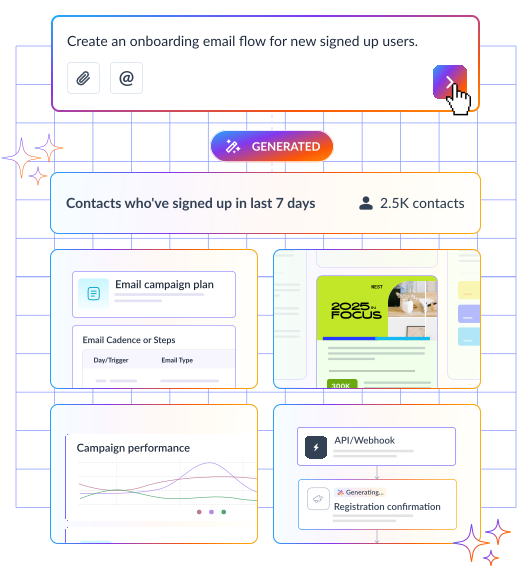
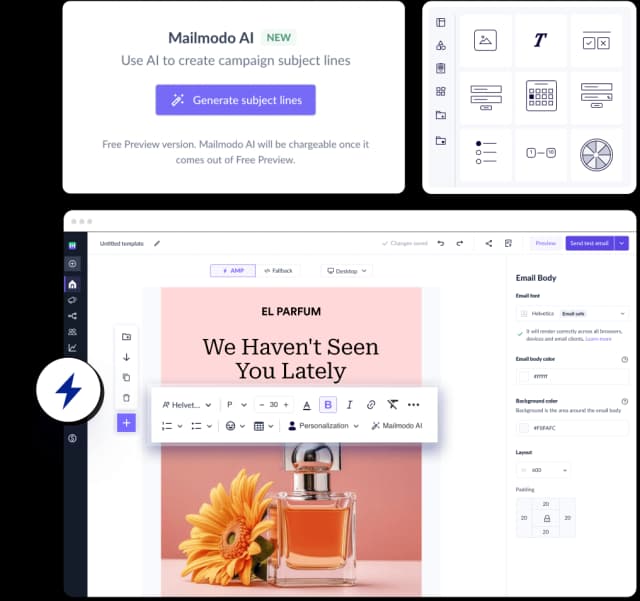
Figuring out what an AI agent is…
AI agents go by a lot of names. Some call them AI employees. Some say smarter automations. Others even call it “autonomous software,” which is so abstract.
After a lot of research, to put it simply, an AI agent is a program that can complete tasks or make decisions on its own using data, AI models, and a set of tools. They work to complete a goal that you set.
If you think about how it’s different from traditional automation or any previous AI innovation, it comes down to how this system gets the work done.
In a traditional approach, a standard prompt takes your input and returns an output in one shot. An agent takes your input, breaks it into steps, calls on tools repeatedly if needed, and figures out the best path to your goal on its own.
How to create an AI marketing agent?
The way you create an AI marketing agent can be a bit subjective. Some marketers build their own agents end-to-end, which can get fairly technical and resource-intensive.
Others collaborate closely with their dev teams to bring them to life. Others collaborate closely with their dev teams or an AI agent development company to bring them to life. It also depends on how complex your idea is, and that usually decides how much effort it takes to deploy an AI marketing agent in practice.
Regardless of the approach, here is a general process you can follow to create your own marketing agent:
-
Every agent that you create is ultimately a solution to the problem you are facing.
Maybe the task is repetitive, and you are bored doing it every day, or you work in a small team and simply don’t have the bandwidth to handle it manually.
If you are not sure what your use case should be, a simple hack is to:
Look at the current marketing projects you are working on
Break down the stages of that campaign.
Figure out what parts can be automated.
For example, at Mailmodo, we were struggling with influencer marketing work. It was difficult for one person to handle both discovery and outreach. So our marketer built an agent that automatically identifies influencers by niche and does outreach.
Design the agent logic
Once the problems are clear, the next step is to define how the agent should operate to solve this problem. You can create an agent logic doc and use AI to write the entire process. Your logic should typically include:
Prompt structure and instructions
Decision logic for different scenarios
Task sequencing (what happens first, next, and after that)
Conditions for tool usage or branching paths
For our influencer marketing agent, the logic was fairly straightforward. It starts by discovering influencers across multiple platforms based on a keyword, then consolidates all that data into one place. From there, the agent analyzes and scores each influencer based on relevance and engagement, filters out the best fits, and finally generates personalized outreach emails for each one.
-
Typically, when building an AI agent, you need a mix of different types of tools depending on what the workflow is trying to achieve. Most setups usually include:
Agent building & automation tools
Generative AI engines
Data management systems for storing and retrieving information
Analytics or monitoring tools based on the use case
Once the tools are selected, the next step is wiring everything together so the agent can actually function end-to-end. This usually involves connecting webhooks and APIs, so data can be transferred between the system seamlessly.
For the influencer agent, this meant connecting discovery sources, AI models for analysis, and a central Google Sheet where all influencer data and outreach drafts could live.
Define prompts and triggers
After the workflow and tools are in place, the next focus is on defining how the agent should think, respond, and when it should actually run. You work on two main parts:
For the influencer agent, this meant writing prompts that helped the AI score influencers consistently and generate outreach messages that felt natural and relevant. Triggers were set so the workflow only ran when new influencer data was available, keeping the process efficient and focused.
Evaluate and iterate the agent
The final step is to evaluate how well the agent performs against human judgment. In the early stage, you should have 5–10 sample outputs and use them as a baseline for comparison.
The key metric here becomes human vs model agreement. If the agent’s decisions match what a human would have done, it is considered reliable. If not, prompts, logic, or data flow are adjusted and tested again until the gap reduces.
Once this loop becomes stable, improving the agent becomes more structured. You can easily :
Swap models when needed
Push small changes to prompts or logic
Score outputs against the baseline
Debug issues with clearer signals and confidence
💡 Related guide: How to Build an AI Agent for SaaS
Example of AI agents you can build for marketing
Here are some agents you can easily build for your marketing tasks:
SEO report agents: Connect your analytics and search console data to an agent that pulls rankings, traffic changes, and keyword gaps on a set schedule. Instead of manually compiling a weekly SEO report, the agent generates a structured summary in a consistent format, ready for your team to review and act on.
Content optimization agents: Feed the agent a draft and a target keyword. It checks readability, heading structure, keyword usage, internal linking opportunities, and meta descriptions, then returns specific suggestions.
Lead research agents: Before an outreach sequence, the agent pulls firmographic data, recent company news, and relevant signals from your CRM to build a prospect summary.
Social media post agents: Give the agent a content brief, a blog URL, or a campaign theme, and it drafts platform-specific posts for LinkedIn, X, or Instagram. A social media scheduler for agents can then automatically publish the approved content across platforms, streamlining the entire workflow from content creation to distribution. You define the tone, format, and brand constraints in a spec, and the agent produces the first draft.
When NOT to build an AI agent
These days, building agents are becoming a major trend. They can significantly improve work efficiency, help employees upskill, and support long-term scalability of a business.
That said, not every situation benefits from automation. In many cases, especially for startups or early-stage teams, deploying an agent can introduce extra setup and maintenance without delivering meaningful value back.
It usually makes sense to skip an agent when:
The task keeps changing: Agents depend on clear instructions. If your campaign direction, messaging, or workflow shifts frequently, you’ll end up constantly updating the setup instead of getting value from it.
The stakes are high: Anything that touches large audiences or customer data needs caution. Sending emails at scale, making content directly live at home page, or updating bulk CRM records should not run fully unattended without strong testing and review in place.
It’s a one-time task: There is setup effort involved in defining how an agent behaves, how it should be tested, and what rules it follows. If the job only happens once, manual execution is usually faster and simpler.
The input data is messy: Agents don’t fix unclear inputs. If your CRM data, naming conventions, or briefs are inconsistent, the output will reflect that noise at scale rather than improve it.
Final thoughts
Creating an AI agent for your marketing work is a strategic decision. While marketing agents can significantly speed up repetitive tasks and improve consistency over time, they also require upfront investment in setup, structure, and ongoing maintenance.
If you are a small business or just getting started, it often makes sense to begin with simpler automation or manual workflows before introducing agents.
If your business has the resources for AI agents, start with one or two high-impact, well-defined workflows, measure the time saved and quality improvement, then expand gradually. This approach keeps the system manageable and ensures the agent is actually improving outcomes instead of adding complexity.