


In the edtech industry, events like webinars, live classes, demo sessions, and online summits are powerful tools to attract prospective learners and introduce them to your courses. These events often act as the first real touchpoint in a learner’s journey, making them critical for building trust and interest early on.
However, learners sign up days or weeks in advance, get busy, forget the date, or lose motivation to attend live. Low attendance rates and last-minute drop-offs are common challenges for edtech teams.
This is where an event registration email sequence makes a real difference. A structured email flow keeps learners informed, builds anticipation, and nudges them to show up at the right moment. In this guide, we’ll walk through how to build a complete event registration email sequence for edtech, step by step.
Why should you use an email flow?
Email works exceptionally well for event registration in edtech because it reaches learners directly in a space where they already consume important information. Unlike ads or social posts, email doesn’t rely on algorithms or limited visibility.
With email, you can:
- Reach registered learners directly with clear event details
- Personalize messages based on the event, course interest, or learner stage
- Segment users based on engagement or registration status
- Automate reminders and live alerts without manual effort
However, one email is rarely enough to drive attendance. Some learners miss the confirmation email, others need reminders to plan their schedule, and many decide to attend only after being reminded of the value. An email sequence ensures multiple touchpoints and keeps the event top of mind until it goes live.
What is an event registration email sequence?
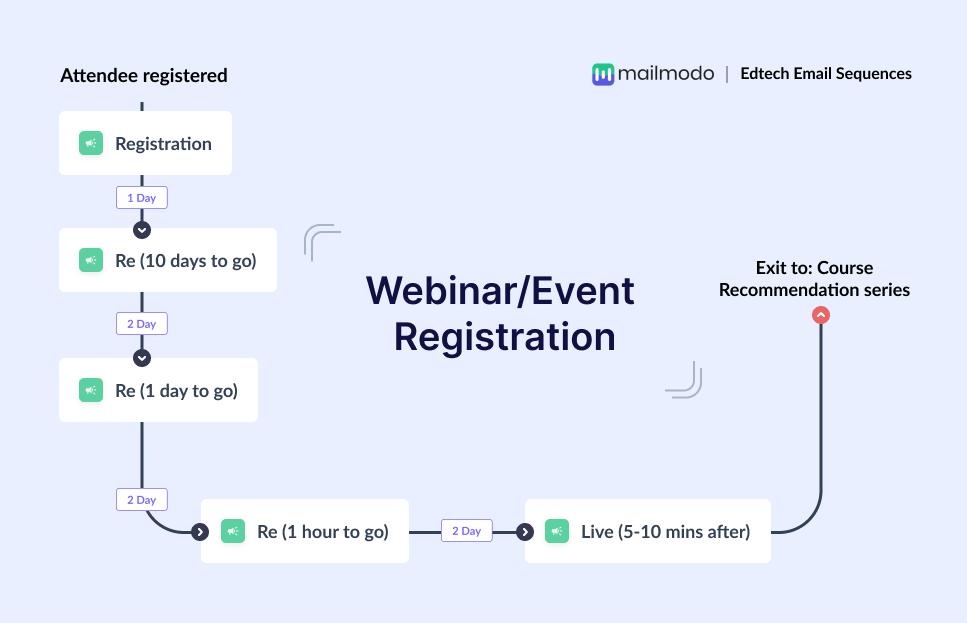
An event registration email sequence is a series of automated emails sent to users after they sign up for an event. The goal is to confirm their registration, remind them about the event, and motivate them to attend live.
It typically includes:
- A registration confirmation email
- One or more reminder emails leading up to the event
- A live or last-minute notification when the event begins
How to build an event registration email sequence
Building an email sequence can be easy if you’re following a well-defined set of steps. Here are the steps for you to follow:
Step 1: Plan your campaign
Planning your campaign helps ensure that every email has a clear purpose and timing. Without this step, reminders can feel random or repetitive. Start by defining the core elements of your event registration flow:
- Objective: Increase live attendance for the event
- Audience: Learners who have registered for the event
- Number of emails: 4 emails
- Timeline: From registration to the event start
We used Mailmodo AI to create a complete campaign plan for an event registration email sequence. It outlined the number of emails, their purpose, and the ideal timing, making it easy to turn the plan into an automated flow.
Take a look at the prompt we used. Click on the arrow to see the output we received.
Create an event registration email campaign plan for an edtech webinar. Include objectives, number of emails, purpose of each email, ideal timing, and main CTA.
Step 2: Create audience segments
Segmentation ensures that only relevant learners receive the event emails and that messaging stays timely and personalized. For an edtech event registration flow, you can segment users based on:
- Event registration status
- Course or topic interest
- Engagement with past emails
- Time zone or location
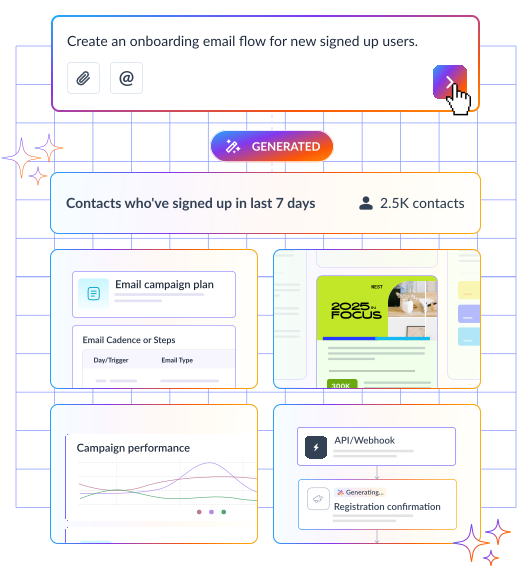
We used Mailmodo AI to quickly create an audience segment of learners who successfully registered for a specific webinar and had not yet attended it. Once it was done, we got the option to review, make edits using the builder, or ask AI to carry out the changes we wanted. Once we confirmed, Mailmodo AI created the segment instantly and it was ready to use for a campaign.
Take a look at the prompt we used, along with the output we got.
Create a dynamic segment of users who registered for an upcoming edtech webinar and have not attended the event yet.
Step 3: Create the email templates
Once the audience is defined, the next step is creating the actual emails to be sent. Here’s a sample list of emails that you should be creating for your event registration email sequence. We’ve also included sample prompts that you can use in Mailmodo AI to generate these email templates in minutes instead of having to spend hours creating them.
Email #1: Registration successful email
When to send: Immediately after registration
Purpose: Confirm the learner’s spot and share key details
What to include:
- Event date and time
- Joining link and passcode if applicable
- Brief overview of what the learner will gain
Here’s a sample prompt to generate this kind of email, along with the output it will produce.
Generate a registration confirmation email for an edtech webinar. Include event details, joining link, and a short value summary.
Email #2: 10 days to go
When to send: 10 days before the event
Purpose: Keep the event top of mind
What to include:
- Reminder of the upcoming event
- Topics or agenda highlights
- Short introduction to speakers or instructors
Here’s a sample prompt to generate this kind of email, along with the output it will produce.
Generate a reminder email for an edtech webinar happening in 10 days. Highlight topics, speakers, and learner benefits.
Email #3: 1 day to go
When to send: One day before the event
Purpose: Drive attendance with a strong value reminder
What to include:
- Final reminder with date and time
- Key takeaways from attending live
- Clear joining instructions
Here’s a sample prompt to generate this kind of email, along with the output it will produce.
Generate a final reminder email for an edtech webinar happening tomorrow. Emphasize value and include joining details.
Email #4: We’re live
When to send: At the start of the event
Purpose: Capture last-minute attendees
What to include:
- Live now notification
- Direct join link
- Urgent, time-sensitive copy
Here’s a sample prompt to generate this kind of email, along with the output it will produce.
Generate a live event email for an edtech webinar that is starting now. Include a direct join link and urgent messaging.
Step 4: Build the automated workflow
Once your emails are ready, the next step is to automate them so every new user receives them at the right moment. Your edtech event registration email sequence should include:
- Trigger: User registers for the event
- Delays: Immediate → a few days → 1 day before → event start time
- Branching logic: Optional checks for engagement
- Exit criteria: Event ends or user attends
We used Mailmodo AI to generate a complete automated workflow from scratch for the event registration email sequence. It mapped the triggers, delays, conditions, and exits. Once the output was ready, we just had to review the overall journey following a setup checklist and ask the AI to make the tweaks we wanted in the workflow.
Take a look at the prompt that we used and the output we received.
Generate a complete automated workflow for an edtech event registration email sequence. Include triggers, delays, branching logic, and exit criteria.
Step 5: Analyze and improve
Once the sequence is live, you can track the performance of your sequence to improve future campaigns. Key metrics to track include:
- Open rates
- Click-through rates
- Event attendance rate
- Drop-offs before the event starts
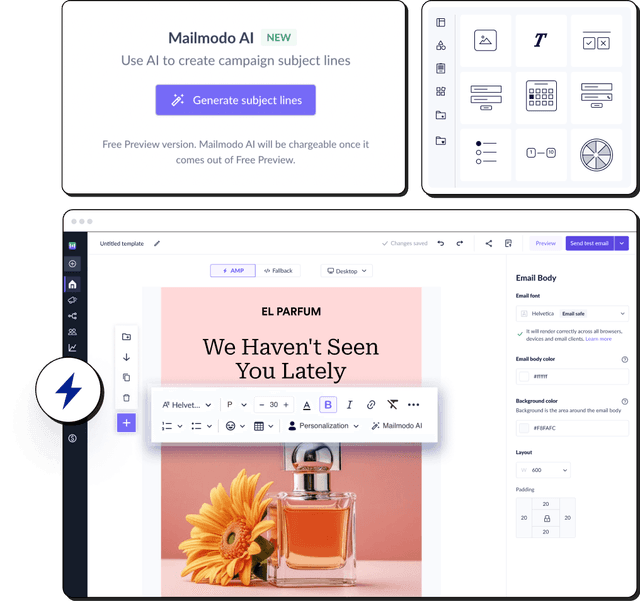
You can also ask Mailmodo AI to analyze the performance of your email sequence and suggest optimizations based on engagement and conversion data. Here’s a sample prompt that you can use for this:
Analyze my event registration email sequence and suggest improvements to increase webinar attendance.
Conclusion
An event registration email sequence ensures consistent communication, builds anticipation, and maximizes live participation. With email automation and thoughtful sequencing, you can deliver timely messages without added effort.
Mailmodo AI simplifies planning, creating, automating, and optimizing event registration email sequences, so every event becomes a stronger growth opportunity.


 Learn more about Mailmodo