Where Mailchimp starts to show its limits
Mailchimp is built for small businesses just getting started, like SMBs, startups, and small ecommerce stores. And their pricing model is geared toward acquiring that base: small business equals small subscriber count equals free plan.
But once your business starts growing and email becomes a core channel for marketing, the pricing rise is huge.
For example, within Mailchimp's Standard plan, going from 5,001–10,000 contacts to 10,001–15,000 contacts means a jump from $135 a month to $230, a 70% increase, even though your contact count only grew by 50%. Work out the cost per contact and it actually goes up, from $0.0135 to $0.0153. The more you grow, the less efficient your plan becomes.
- Key features are gated behind higher tiers. For example, automation isn't even available on the free plan anymore, and dynamic content (personalization based on subscriber behavior) is Premium-only. Onboarding help is rationed too, like 4 sessions on Premium, 1 on Standard, none on Essentials.
- The free plan's limits keep shrinking. It's gone from 2,000 contacts in 2022, to 500 in 2023, to 250 contacts and 500 monthly sends as of January 2026, a steady erosion of the plan that built Mailchimp's reputation in the first place.
- Support quality is inconsistent. Reviews on Capterra and Trustpilot point to a recurring pattern: solid support when things are minor, but slow or unhelpful responses (including AI chat that loops without resolving the issue) when something's actually broken, like an account getting flagged or emails failing to deliver.
8 best Mailchimp alternatives
1. Brevo
Brevo's biggest edge over Mailchimp is how it charges you. Instead of pricing based on how many contacts you have, most Brevo plans price based on how many emails you actually send each month.
For example, its Business plan at $18/month covers unlimited contacts, so a list of 50,000 people costs the same as a list of 5,000, as long as your sending volume stays within plan limits, something Mailchimp can't match since it bills by contact count regardless of how often you actually email them
The second real advantage is that automation and segmentation are free on Brevo, even on the entry-level plan, while Mailchimp locks its full segmentation builder behind the Standard plan.
Other key features:
- Transactional email included free on every plan, including the free tier
- Built-in sales CRM with pipeline tracking, not just email tools
- Live chat widget with chatbot automation for on-site conversations
- SMS, WhatsApp, and web push campaigns alongside email
- Meeting scheduling and phone features for managing sales conversations
Pricing:
| Plan |
Price(monthly) |
Notes |
| Free |
$0 |
Unlimited contacts, 300 emails/day, automation, CRM, segmentation |
| Starter |
From $9 |
5,000 emails/month, advanced segmentation, forms |
| Standard |
From $18 |
Small businesses ready to automate and test campaigns |
| Professional |
From $499 |
Teams using data and AI to drive growth across channels |
| Enterprise |
Custom |
Companies with 1M+ contacts needing full data control |
2. Mailmodo
We know this looks a bit biased, but trust us, it does have its merit that makes this deserving. Mailmodo serves a similar customer base to Mailchimp and offers far greater value for money for bigger subscriber lists. The Pro plan runs $99 a month for 10,000 contacts, compared to Mailchimp's Standard plan at $135 a month regular pricing.
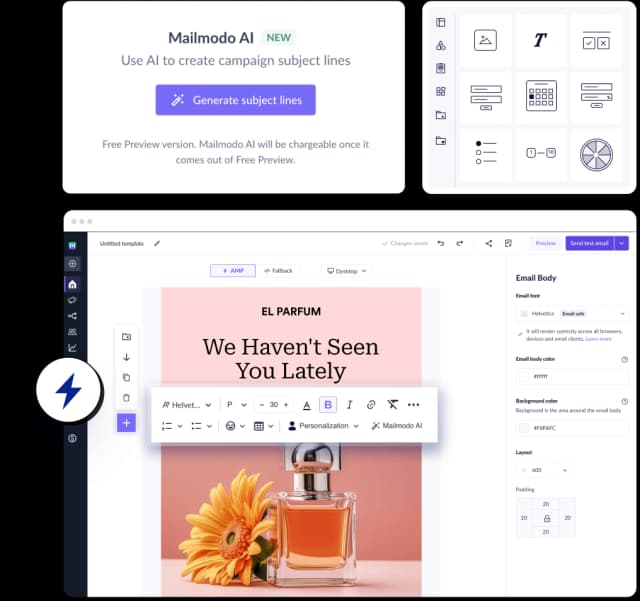
Additionally, Mailmodo is often talked about for its AMP email widgets, but in practice, that's a bonus. The platform itself is simply easier to use day to day: domain authentication takes a few clicks, and the segmentation flexibility is some of the easiest we've worked with, letting you build precise audience segments without wrestling with a clunky rule builder.
Other key features:
- Campaign overview on the home page showing how emails are performing
- User engagement analysis showing exactly who clicked where
- Dynamic editor that lets you add elements to emails easily
- Multi-preview option to check how emails render across clients
- Dedicated chat, email, and call support included on higher tiers
Pricing
| Plan name |
Pricing (10,000 contacts, billed annually) |
| Lite |
$59 |
| Pro |
$99 |
| Max |
Custom |
Constant Contact is built for email marketing beginners who want a lot of hand-holding along the way. Its reporting is built with less experienced marketers in mind. Where Mailchimp's analytics suite leans into depth, comparative reports, Constant Contact keeps its dashboard to simple, easy-to-read bar charts that surface the numbers that actually matter without requiring you to interpret much.
It's also one of the platforms on this list with genuinely strong phone and live chat support at every tier, something Mailchimp only unlocks on its most expensive Premium plan, plus live 1:1 onboarding with real experts from the moment you sign up.
Other key features:
- AI copy generator and drag-and-drop email editor on every plan
- Social posting to Facebook, Instagram, LinkedIn, and more
- Social media ads manager, with Facebook lookalike targeting on Standard+
- 300 integrations including Shopify, Canva, Eventbrite, and Zapier
- SMS add-on from $10/month, included free on Premium
Pricing:
| Plan |
Price/mo |
Best for |
| Lite |
$12 |
Beginners starting with email and social |
| Standard |
$35 |
Growing businesses wanting automation |
| Premium |
$80 |
Pros needing advanced segmentation and dynamic content |
| Teams |
Custom |
Teams managing multiple locations |
4. Omnisend
Omnisend is built specifically for ecommerce, and its edge over Mailchimp shows up most in automation and segmentation tied to store behavior. It combines email, SMS, and push notifications in a single visual automation builder, so a flow like abandoned cart, browse abandonment, or post-purchase follow-up can branch across channels without needing separate tools.
The segmentation builder supports up to 500 data points with no cap on how many segments you create, including a Lifecycle stage map that groups customers by shopping recency and order value, something Mailchimp doesn't offer natively.
Other key features:
- 300+ pre-made templates with product picker and brand asset syncing
- Gamified popups (Wheel of Fortune) for list-building
- Pre-built segments based on shopping behavior and churn risk
- SMS credits available from $0.007, layered on top of any paid plan
- Free 5-day migration service that moves your lists, flows, and templates
Pricing :
| Plan |
Price/mo |
Notes |
| Free |
$0 |
250 contacts, 500 emails/mo |
| Standard |
$11.20 |
500 contacts, 6,000 emails/mo |
| Pro |
$41.30 |
2,500 contacts, unlimited emails/mo |
5. Beehiiv
Beehiiv isn't a direct Mailchimp alternative in the traditional sense. But it's a strong option if you're niching down to newsletters as a tactic to grow your audience or monetize the effort. Its built-in ad network connects you with sponsors and has a referral program that turns your own readers into a distribution channel.
Plus automation is quite stronger than people expect; you have unlimited steps, conditional branching based on subscriber behavior, and pre-built templates for things like re-engagement flows and welcome sequences, though it's gated to the Scale plan and it's built around content and audience triggers rather than the deep ecommerce customer-journey logic Mailchimp offers.
Other key features:
- AI writing assistant and Smart Editor to draft, shorten, or extend copy
- Boosts: paid cross-promotion with other newsletters, filterable by category
- Payouts for ad and referral earnings run through Stripe Express
- Built-in website builder, so your newsletter archive works as a full site
- Native integrations with Stripe, Shopify, Zapier, and Make
Pricing:
| Plan |
Price/mo |
| Launch |
Free (up to 2,500 subscribers) |
| Scale |
From $43 |
| Max |
From $96 |
| Enterprise |
Custom |
6. MailerLite
MailerLite's biggest win over Mailchimp is straightforward value. At 2,500 subscribers, MailerLite runs about $25 a month with unlimited sends, while the equivalent Mailchimp plan costs around $69 a month and still caps how many emails you can send before charging overage fees.
It's also simpler for day to day usage. MailerLite uses simple segmentation rules instead of Mailchimp's audience structure. The editor loads faster too, and 24/7 support is included at every plan level, including free, something Mailchimp only offers on paid tiers.
Other key features:
- Unlimited monthly sends included on every paid plan
- Built-in landing pages, signup forms, and website builder
- Ecommerce automation for Shopify and WooCommerce, including abandoned cart
- Revenue attribution to track what campaigns actually drive sales
- Clean drag-and-drop editor with strong deliverability track record
Pricing:
| Plan |
Price/mo |
Notes |
| Free |
$0 |
Up to 1,000 subscribers, 12,000 emails/mo |
| Growing Business |
From $10 |
500 subscribers, unlimited sends |
| Advanced |
Higher, scales with list |
Adds collaboration tools, fewer limits |
| Enterprise |
Custom |
For large-scale senders |
7. Moosend
Moosend's main advantage over Mailchimp is that its more advanced automation, the kind usually reserved for pricier platforms, is available starting at just $9 a month. Its visual automation builder supports complex branching, conditional "wait until" logic, and cross-campaign triggers, letting you do things like lead scoring or VIP tagging based on website behavior.
Moosend is also one of the few platforms that doesn't charge you for unsubscribed or duplicate contacts, a real cost-saver compared to Mailchimp's billing model, which counts inactive contacts toward your total unless you manually clean your list.
Other key features:
- Unlimited lists and segments with no duplicate-contact billing
- Landing pages, subscription forms, and SMTP server included
- Free Mailchimp-to-Moosend migration tool for campaigns and audiences
- Audience Discovery for smart segments based on purchase behavior
- In-depth analytics and campaign performance insights
Pricing:
| Plan |
Price/mo |
Notes |
| Free trial |
$0 |
30-day trial with full Pro feature access |
| Pro |
From $9 (billed annually: $7) |
Unlimited sends, automation, landing pages, SMTP |
| Moosend+ |
Custom |
Adds transactional email, dedicated IP, custom reports |
| Enterprise |
Custom |
Dedicated account manager, priority support |
8. EmailOctopus
EmailOctopus strips email marketing down to the essentials and prices it accordingly. The free plan covers up to 2,500 subscribers, ten times what Mailchimp's free plan allows in 2026.
it. It's popular with a distinctly different crowd than Mailchimp, such as bloggers, indie hackers, crypto and Web3 groups, musicians, and niche newsletter writers, people who want a tool that just sends clean, reliable emails without a cluttered interface pushing website builders or social scheduling at them.
Other key features:
- Drag-and-drop email builder and no-code signup forms
- Email automation and list segmentation on paid plans
- Landing pages included without needing a higher tier
- Zapier and Make integrations for connecting other tools
- Straightforward migration process, most switches completed in an afternoon
Pricing:
| Plan |
Price/mo |
Notes |
| Free |
$0 |
Up to 2,500 subscribers, 10,000 emails/mo |
| Paid |
From $9 |
Scales linearly with list size, no surprise tier jumps |
Which one should you actually pick
Mailchimp isn't a bad platform, and this list isn't about tearing it down. It's still a reasonable place to start if you're under a few hundred contacts and email is a side channel, not a core one. But once your list grows, your pricing per contact should be getting better, not worse, and once automation, segmentation, or support start feeling like they're locked behind a paywall you didn't budget for, that's the hint to look elsewhere.
- If cost efficiency at scale matters most, Mailmodo, Brevo, and MailerLite make the strongest case.
- If you're running an online store, Omnisend is the more purpose-built option.
- If you're a beginner who wants a human on the phone, Constant Contact fills that gap.
- If your business is really a newsletter, Beehiiv is worth a serious look over any traditional ESP.
- If you just want the essentials without paying for a marketing suite you'll never use, Moosend and EmailOctopus are both solid, low-friction choices.
Final Thoughts
The best way to figure out which of these actually fits your business is to stop reading comparisons and start testing. Most of these platforms offer a free plan or trial, so take advantage of that before committing to anything. Build out a real campaign, run a segment or two, and see how the platform actually feels to work in day to day, not just how it looks on a pricing page.
If you're not sure where to begin, start testing with Mailmodo. It's free to get going, and given everything covered above, it's the strongest overall replacement for Mailchimp across cost, ease of use, and features.