What is a follow-up email after an interview?
A follow-up email after an interview is a short, professional message sent to your interviewer after your conversation. It serves three purposes: to thank them for their time, to reaffirm your interest in the role, and to keep you top of mind while they make their hiring decision.
This email can take the form of a thank-you note sent within hours of the interview, a status check after a few days of silence, or a response to a rejection that keeps the door open for future opportunities.
Why does sending a follow-up email after an interview matter?
A follow-up email after an interview benefits both sides of the hiring process. Here is why it matters, whether you are the one hiring or the one being hired.
For employers
When a candidate takes the time to follow up thoughtfully, it tells you a lot about how they will show up on the job. It signals initiative, communication skills, and genuine interest in the role rather than a spray-and-pray job search approach. According to a survey by TopResume, 68% of hiring managers say receiving a post-interview thank you email directly impacts their hiring decision. And nearly one in five interviewers have dismissed a candidate entirely for not sending one. A follow-up also gives candidates a chance to address any concerns raised during the interview, saving your team time in the evaluation process.
For candidates
The numbers make a clear case for always sending one. Monster and Robert Half data show that 80% of hiring managers say thank-you notes are helpful when deciding between candidates. Glassdoor data shows that 86% of candidates who sent a follow-up felt it improved their chances. And Accountemps found that 91% of hiring managers say they genuinely like being thanked.
The most striking stat of all: only 24% of job seekers actually send a thank you note after an interview. That means if you send one, you instantly stand out from three-quarters of the candidates competing for the same role, before the hiring manager has even finished reading it.
How to write a follow up email after an interview
Every strong follow up email hits four elements in this order.
1. Thank them specifically
Generic openers like "Thank you for the opportunity" blend into the background. Instead, reference what you are specifically thanking them for. "Thank you for walking me through how the team approaches X" lands very differently from a form response.
Think back to a moment in the interview that genuinely interested or surprised you. Maybe they shared a challenge the team is working through, or gave you a candid view of how the company operates. That is your hook. Referencing it shows you were listening, not just performing.
2. Reference something real from the conversation
This is the most important element of any interview thank you email. Mention a topic you discussed, a challenge they raised, or an insight they shared. Candidates who personalise their follow up by referencing specific moments from the interview have a 30% higher response rate than those who send generic notes.
If you interviewed with multiple people, make sure your references are specific to each person. What did this interviewer particularly ask or talk about? Write that down right after the interview ends, before the details fade. The more specific you are, the more your email feels like a real continuation of the conversation rather than a template.
3. Reinforce your fit briefly
Connect one specific skill or experience to something they care about. One or two sentences is enough. The goal is to remind them why you are the right person, not to repeat your entire resume.
For example, if the interviewer mentioned they are struggling with a particular process and you have solved a similar problem before, this is the moment to connect those dots. Be direct and concrete. "My experience streamlining X at [Company] is directly relevant to what you described" is more effective than a vague "I believe I would be a great fit."
4. Close with one clear ask
Express continued interest, note any next steps that were discussed, and offer to answer any remaining questions. Keep it to a single ask. Stacking multiple questions into one closing paragraph signals anxiety rather than confidence.
If a timeline was discussed during the interview, reference it lightly in your close. Something like "I look forward to hearing from you by [date] as discussed" shows you were paying attention and sets a natural expectation without being pushy.
Getting the content right is only half the job. How you format and deliver the email matters just as much.
Keep your thank you email between 100 and 200 words. A no-response follow-up should be even shorter, around 80 to 130 words. Hiring managers are reviewing multiple candidates, and a concise, well-structured email is far more likely to be read in full than a lengthy one.
Match the tone of your interviewer. If they were formal, keep your email professional. If the conversation was relaxed and on a first-name basis throughout, a warmer tone is appropriate. Getting the tone wrong, either too stiff for a casual culture or too casual for a formal one, can undermine an otherwise strong email.
Always proofread before you hit send. A typo in a follow-up email is more noticeable than a typo in a resume because it is the last thing they see from you before making their decision. Read it once for content, once for grammar, and once out loud to catch anything that sounds off.
One practical shortcut: if you already have an email thread with the recruiter or hiring manager, reply to that thread rather than starting a new one. It appears at the top of their inbox with full context and reads as a natural continuation of the conversation rather than a cold new message.
When should you send a follow-up email after an interview?
Now that you know how to write it, timing is the next piece. Sending the right email at the wrong time is just as ineffective as not sending one at all. Here is the framework to follow based on your situation.
| Situation |
When to Send |
| Thank you after the first interview |
Within 24 hours, same day preferred |
| Thank you after a phone screen |
Within 24 hours, keep it concise |
| Thank you after a panel or second interview |
Within 24 hours, send a separate note to each person |
| First follow-up with no response |
After the stated deadline, or 5 to 7 business days post-interview |
| Second follow-up with still no response |
5 to 7 business days after your first follow-up |
| You have received a competing offer |
Immediately, before their decision deadline |
| Responding to a rejection |
Within a few days of receiving it |
11 follow-up email after interview templates
Template 1: Standard thank you email after a first interview
Use this as your default template for any first-round interview.
Subject: Thank you, [Your Name], [Role Title] interview
Dear [Interviewer's Name],
Thank you for taking the time to speak with me today about the [Role Title] position at [Company Name]. I genuinely enjoyed our conversation, especially your thoughts on [specific topic you discussed, such as the team's approach to X or the challenge around Y].
It reinforced my excitement about this opportunity. In particular, my background in [specific skill or experience] feels like a strong fit for what you are building with [specific goal or project they mentioned].
I look forward to hearing about the next steps and am happy to share anything further that would help with your decision.
Thank you again for your time.
Best regards,
[Your Name]
Template 2: Short thank you email after a phone screen
Use this after a brief recruiter call or phone screen where a shorter note is more appropriate.
Subject: Thank you, [Your Name], [Role Title] call
Hi [Name],
Thank you for taking the time to speak with me today about the [Role Title] role. It was great to learn more about [Company Name] and the team's focus on [something from the call].
I am very interested in moving forward and look forward to the next steps. Please reach out if you need anything else from me.
Best, [Your Name]
Template 3: Thank you after a panel interview or multiple interviewers
Send a separate, individually personalised note to each person who interviewed you. Never group them in a single CC.
Subject: Thank you, [Your Name], [Role] interview
Dear [Interviewer's Name],
Thank you for being part of the interview today for the [Role Title] role. I particularly valued your perspective on [specific thing they mentioned or asked]. It gave me a much clearer sense of how the team thinks about [topic or challenge].
The more I learn about [Company]'s direction on [project or goal], the more clearly I can see how my experience with [skill or project] fits into that vision.
I look forward to the next steps and am eager to contribute to the team.
Thank you,
[Your Name]
Template 4: First follow-up email after interview with no response
Use this after the stated decision deadline has passed, or 5 to 7 business days after the interview if no timeline was given.
Subject: Following up on [Role Title] interview, [Your Name]
Dear [Hiring Manager's Name],
I wanted to follow up on my interview for the [Role Title] position on [date]. I understand that hiring decisions take time and I simply wanted to confirm that I remain very interested in the role and ask whether there are any updates on the timeline.
Please let me know if there is any additional information I can provide to support your decision.
Thank you for your consideration.
Best regards,
[Your Name]
Template 5: Second follow-up email after interview with still no response
Use this 5 to 7 business days after your first follow-up if you still have not heard back. Keep it shorter and more direct.
Subject: Re: [Role Title], [Your Name]
Hi [Name],
I hope you are doing well. I am following up once more on my candidacy for the [Role Title] role. I understand the process takes time, and I do not want to intrude. I simply wanted to reiterate my continued interest before a final decision is made.
Please let me know if there is anything else I can provide. Thank you for your time.
Best,
[Your Name]
Template 6: Thank you after a second interview
Subject: Thank you, [Your Name], second round for [Role Title]
Dear [Interviewer's Name],
Thank you for having me back for a second interview for the [Role Title] role. I genuinely appreciated the opportunity to go deeper on [specific topic from this round] and to meet [other team members, if applicable].
Our conversation strengthened my belief that my experience with [specific skill or project] would directly support [specific goal or challenge they discussed]. I am excited about the direction the team is heading.
I look forward to hearing about the next steps. Please let me know if there is anything further I can share.
Thank you again,
[Your Name]
Template 7: Follow-up email when you have a competing offer
Use this as soon as you have an offer deadline from another company and need to prompt a decision.
Subject: [Role Title] update on timeline, [Your Name]
Dear [Name],
I hope you are doing well. I wanted to follow up on the [Role Title] position I interviewed for on [date].
I have recently received an offer from another company and have been asked to respond by [date]. I want to be transparent because [Company Name] remains my first choice. I wanted to allow you to weigh in before I make a final decision.
Please let me know if you can share any updates. I appreciate your time and consideration.
Best regards,
[Your Name]
Template 8: Thank you email that addresses a concern the interviewer raised
Use this when the interviewer flagged a specific doubt or gap during the conversation. Addressing it head-on shows self-awareness and confidence.
Subject: Thank you, [Your Name], [Role Title] interview
Dear [Name],
Thank you for the conversation today about the [Role Title] role. I appreciated your directness throughout.
I wanted to follow up on the concern you raised about [specific concern, such as limited experience with X]. I understand why that matters for this role. At [Previous Company], I encountered a similar situation where I [specific approach you took], which resulted in [concrete outcome]. I am confident I can close that gap quickly given [specific reason].
I remain genuinely excited about this opportunity and believe my experience with [skill] would bring real value to the team.
Thank you again, and I look forward to hearing about next steps.
Best,
[Your Name]
Template 9: Response to a rejection that keeps the door open
Sending a gracious reply to a rejection is something almost no candidate does. It leaves a lasting impression and can lead to future opportunities.
Subject: Re: [Role Title], thank you
Dear [Name],
Thank you for letting me know and for the time your team invested throughout the process. While I am disappointed, I have genuine respect for the decision and remain an admirer of the work [Company] is doing.
If a relevant opportunity opens up in the future, I would welcome the chance to reconnect. I wish you and the team continued success.
Best regards,
[Your Name]
Template 10: Follow up when the interviewer did not show up
Use this 10 to 15 minutes after the scheduled interview time if the interviewer has not joined or responded.
Subject: [Role Title] interview, checking in
Hi [Name],
We had a [call/video] interview scheduled for [time] today, and I wanted to reach out in case there was a connection issue or a change on your end.
I am happy to wait a few more minutes or reschedule at a time that works better for you.
Best,
[Your Name]
Use this when the interview had a relaxed, first-name-basis tone throughout.
Subject: Great chat today, [Your Name]
Hi [First Name],
Really enjoyed our conversation today. The way your team is thinking about [topic they mentioned] is genuinely exciting, and I came away even more enthusiastic about the role.
I think my experience with [specific thing] would fit naturally into what you are building. Looking forward to seeing what comes next.
Feel free to reach out if you want to explore anything further.
[Your Name]
Common mistakes to avoid in a follow-up email after an interview
Even a well-intentioned email can work against you if you fall into one of these traps.
Waiting too long. Sending a thank you email two or three days after the interview signals low enthusiasm. Twenty-four hours is your window, and the same day is better.
Being too generic. "Thank you for your time and the opportunity" tells the hiring manager nothing about you. The specific reference to your actual conversation is what makes you memorable.
Following up before the deadline. If the interviewer said they would decide by Friday, do not email on Thursday. Respect the timeline they gave you.
Group emailing all interviewers. Send individual notes to each person who spoke with you. A group CC looks lazy and undermines the personalisation that makes these emails effective.
Asking multiple questions at once. End every follow up with one clear ask. Stacking questions signals that you have not thought about what matters most.
Apologising for following up. You do not need to open with "Sorry to bother you." Following up is professional and expected. Lead with your intent directly.
Sending more than two follow-ups. After your initial thank you and one or two follow-ups, further emails are unlikely to change anything. Move on while keeping the relationship warm on LinkedIn.
How Mailmodo can help you write better emails
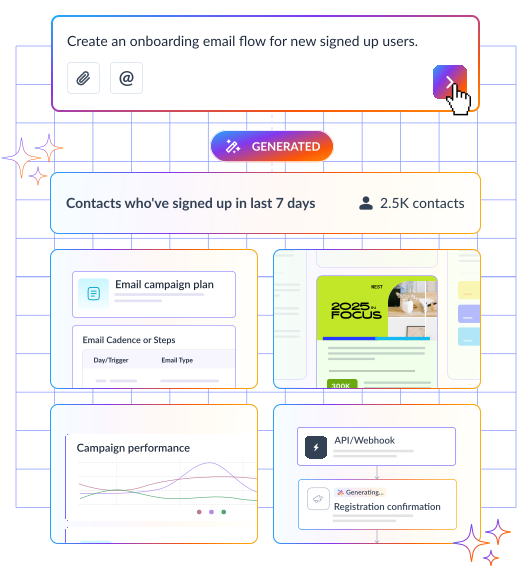
Writing follow-up emails is just one part of professional email communication. If you are a marketer, recruiter, or business professional looking to send better outreach, nurture, or follow-up emails at scale, Mailmodo's AI Email Writer is the fastest way to get started.
Simply describe what you need, and the AI generates a complete, professional email draft in seconds. No starting from a blank page, no spending 20 minutes rewording the same paragraph. Here is what makes it useful:
Built for email marketers and outreach teams. The AI Email Writer is designed for business email communication, from follow-up sequences to cold outreach to transactional emails.
Links directly to Mailmodo's best-performing templates. Rather than writing from scratch, you can browse hundreds of proven email templates across every use case and customise them instantly.
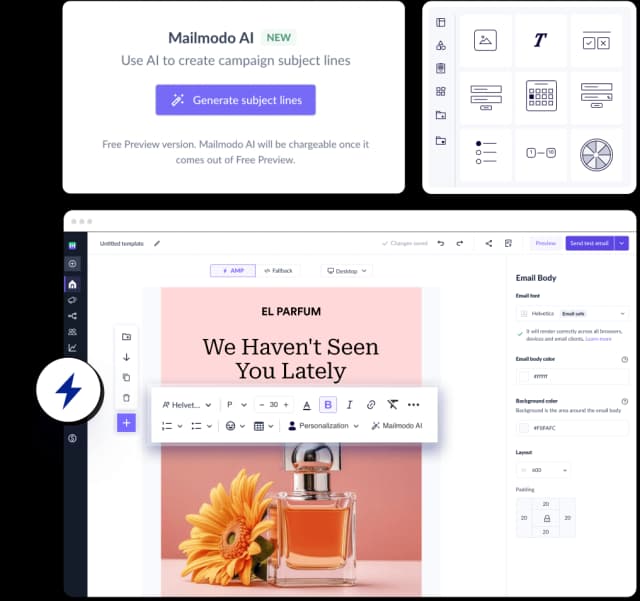
Pair it with the AI Subject Line Generator. Once your email is written, use Mailmodo's free AI Subject Line Generator to test multiple subject line options and pick the one most likely to get opened.
Wrapping up
A follow-up email after an interview is one of the smallest actions in a job search and one of the most overlooked. In a competitive market where two candidates are often equally qualified, this single email, sent promptly, written specifically, and crafted with care, is frequently what makes the difference.
Use the templates above as your starting point, personalise every one, reference something real from the conversation, and send it the same day.