

In fintech, getting users to explore a product is not that hard. Whether it’s a credit card, investment plan, insurance policy, or loan, many users drop off after browsing or even adding a product to their cart.
This happens for real reasons. Financial decisions feel risky. Users want to compare options, understand fees, check eligibility, or simply “think about it later.” Unfortunately, “later” often turns into never.
That’s why fintech teams need a structured way to re-engage these high-intent users. A browse/cart abandonment email flow helps you in doing just that by reducing hesitation and guiding users back to completing their application or purchase.
In this guide, we’ll walk through how to build a complete fintech browse/cart abandonment email sequence.
Why should you use an email flow?
When users abandon a fintech product mid-journey, timing and trust matter more than anything else. Email gives you a direct, permission-based channel to follow up without being intrusive.
Email works especially well for fintech abandonment because:
- You can personalize messages based on the exact product viewed or added to cart
- You can explain complex financial products in a calm, educational way
- You can address objections like fees, returns, or eligibility over time
- You can automate follow-ups while staying compliant
One reminder is rarely enough in fintech. Users need reassurance, education, and a final push before making a decision. That’s why a short sequence with multiple touchpoints works better than a single abandonment email.
What is a fintech browse/cart abandonment email sequence?
A fintech browse/cart abandonment email sequence is a series of automated emails sent to users who viewed or added a financial product to their cart but didn’t complete the purchase or application.
The sequence usually includes:
A reminder showing the product they viewed or abandoned
Educational or trust-building content to reduce hesitation
A final nudge with urgency or an incentive
How to build a fintech browse/cart abandonment email sequence
Building an email sequence can be easy if you’re following a well-defined set of steps. Here are the steps for you to follow:
Step 1: Plan your campaign
Before creating emails or workflows, you need a clear plan. In fintech, this ensures your messaging stays compliant, helpful, and aligned with user intent. You can start by outlining:
- Objective: Recover abandoned applications or purchases
- Audience: Users who viewed or added a financial product but didn’t convert
- Core message: Return to complete the purchase
- Number of emails: 3
- Timeline: Spread across 3-5 days
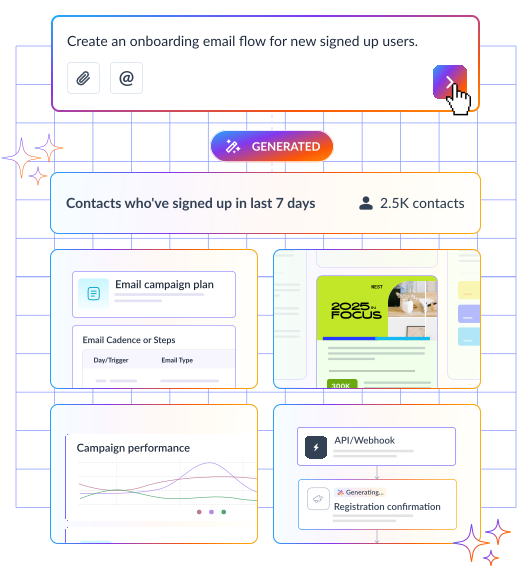
To speed this up, we used Mailmodo AI to generate a complete campaign plan. It gave us a clear breakdown of email themes, timing, and CTAs, which we could easily customize for different fintech products.
Take a look at the prompt we used. Click on the arrow to see the output we received.
Create a browse/cart abandonment email campaign plan for a fintech product. Include objectives, number of emails, email themes, ideal timing, and primary CTA for each email.
Step 2: Create audience segments
Segmentation is critical in fintech because user intent varies widely. Someone browsing a credit card behaves very differently from someone exploring mutual funds to invest in. Some common segments you can segment users on include:
- Product viewed (credit card, investment, insurance, loan)
- Funnel stage (browse vs cart)
- Eligibility check completed or not
- Returning vs new user
- Device or platform (app or web)
We used Mailmodo AI to quickly create an audience segment for this email sequence. Once it was done, we got the option to review, make edits using the builder, or ask AI to carry out the changes we wanted. Once we confirmed, Mailmodo AI created the segment instantly and it was ready to use for a campaign.
Take a look at the prompt we used, along with the output we got.
Create a dynamic segment of fintech users who viewed or added a product to cart but did not complete the purchase or application in the last 3 days.
Step 3: Create the email templates
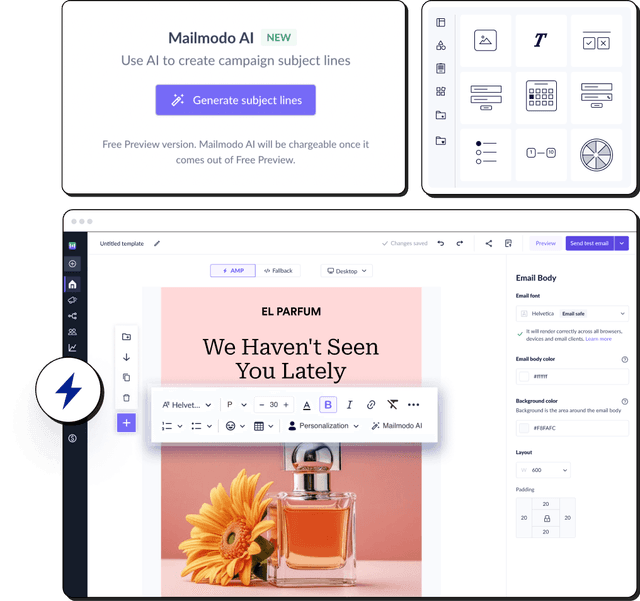
Once the audience is defined, the next step is creating the actual emails to be sent. Here’s a sample list of emails that you should be creating for your fintech abandoned cart email sequence. We’ve also included sample prompts that you can use in Mailmodo AI to generate these email templates in minutes instead of having to spend hours creating them.
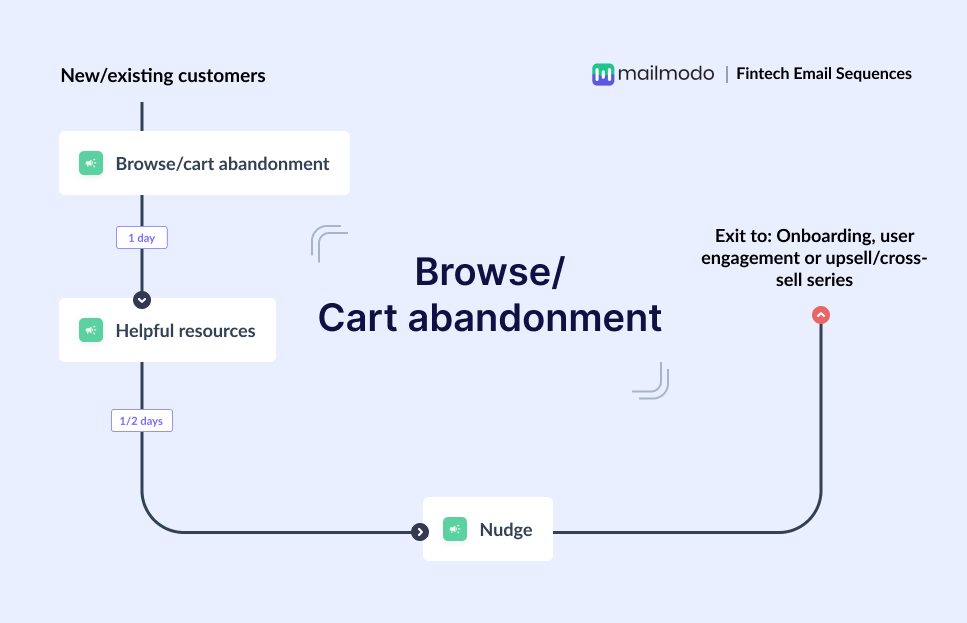
Email #1: Browse/cart abandonment
When to send: Within 1 hour to 1 day of abandonment
Purpose: Remind users about the financial product they viewed or left in their cart while intent is still high.
What to include:
- Product name and key benefits
- Visual or summary of the selected product
- Clear next step (continue application or checkout)
- Trust elements like ratings or compliance badges
Here’s a sample prompt to generate this kind of email, along with the output it will produce.
Generate a browse/cart abandonment email for a fintech product. Include product benefits, reassurance, and a CTA to complete the purchase or application.
Email #2: Helpful resources
When to send: 1–2 days after Email #1
Purpose: Educate users who are hesitating due to lack of clarity or confidence.
What to include:
- Short explanation of how the product works
- Links to articles, guides, or calculators related to the product
- Common FAQs or use cases
- Risk disclosures or compliance-friendly explanations
Here’s a sample prompt to generate this kind of email, along with the output it will produce.
Generate a fintech email that shares helpful resources explaining a financial product, its benefits, and common questions to reduce hesitation.
Email #3: Nudge
When to send: 2–3 days after Email #2
Purpose: Give users a final push to act before interest fades.
What to include:
- Reminder of the product they explored
- Limited-time incentive (if applicable)
- Urgency-driven CTA
- Support or help option
Here’s a sample prompt to generate this kind of email, along with the output it will produce.
Generate a final nudge email for a fintech browse/cart abandonment sequence. Include urgency, reassurance, and a clear CTA to complete the purchase.
Step 4: Build the automated workflow
Once your emails are ready, the next step is to automate them so every new user receives them at the right moment. Your abandonment email sequence should include:
- Trigger: User browses or adds a fintech product to cart
- Delays: 0–1 day → 1–2 days → 2–3 days
- Branching logic: If user converts → exit flow; If user engages but doesn’t convert → continue
- Exit criteria: Purchase or application completed
We used Mailmodo AI to generate the full automated workflow from scratch. It mapped the triggers, delays, conditions, and exits. Once the output was ready, we just had to review the overall journey following a setup checklist and ask the AI to make the tweaks we wanted in the workflow.
Take a look at the prompt that we used and the output we received.
Generate a complete automated workflow for a fintech browse/cart abandonment email sequence. Include triggers, delays, branching logic, and exit criteria.
Step 5: Analyze and improve
Once the sequence is live, you can track the performance of your sequence to improve future campaigns. Key metrics to track include:
- Open rate
- Click-through rate
- Conversion rate
- Drop-off stage
- Time to conversion
You can also ask Mailmodo AI to analyze the performance of your email sequence and suggest optimizations based on engagement and conversion data. Here’s a sample prompt that you can use for this:
Analyze my fintech browse/cart abandonment email sequence and recommend improvements to increase conversions.
Conclusion
Browse and cart abandonment is inevitable in fintech, but lost conversions don’t have to be. Users need time, clarity, and reassurance before committing to financial products and a well-timed email sequence can be highly effective.
With Mailmodo, planning, creating, automating, and optimizing fintech abandonment email flows becomes much simpler, allowing teams to focus on delivering value and trust at every step.


 Learn more about Mailmodo