


It’s not uncommon to see users stop using a banking app, investment platform, or payments product because of trust issues, missing features, poor onboarding, or simply a change in financial needs.
What makes churn especially challenging in fintech is that once users leave, they rarely come back on their own. Competition is high, switching costs are low, and trust takes time to rebuild. Ignoring churned users means losing valuable feedback and missing opportunities to re-engage customers who already understand your product.
This is where a churned customer email sequence helps. Instead of letting these users disappear silently, a well-planned email flow helps you understand why they left and keeps the relationship alive for future reactivation.
In this guide, we’ll walk through how to build a complete fintech churned customer email sequence from scratch.
Why should you use an email flow?
Email works especially well for reaching churned fintech users because it lets you reconnect without forcing them back into the app. Unlike push notifications or in-app messages, email feels less intrusive and gives users the freedom to engage when they’re ready.
With email, you can:
- Reach churned users directly without requiring app activity
- Ask for honest feedback in a calm, non-pressuring way
- Personalize messages based on account type, past usage, or lifecycle stage
- Automate follow-ups that keep the relationship warm over time
However, a single email rarely achieves all of this. Some users may overlook the first message, others may need time before responding, and some only engage after a gentle follow-up. An email flow allows you to gather insights first and then stay connected, making churn communication far more effective as a sequence rather than a one-off email.
What is a churned customer email sequence?
A churned customer email sequence is a set of automated emails sent to users who have stopped using a product for a defined period, usually 2–3 months, to understand their reasons for leaving and maintain a relationship for future reactivation.
This sequence typically includes feedback requests, follow-ups, and keep-in-touch emails that acknowledge churn without being pushy. Once the intent is clear, you can build the sequence using a structured framework.
How to build a churned customer email sequence
Building an email sequence can be easy if you’re following a well-defined set of steps. Here are the steps for you to follow:
Step 1: Plan your campaign
Planning sets the foundation for the entire email sequence. Without clarity on goals and timing, your emails can feel random and irrelevant. You can start by outlining:
- Objective: Collect honest feedback and stay connected
- Target audience: Users inactive for 2–3 months
- Core message: You value their experience and want to improve
- Number of emails: 2
- Timeline: Spread across 3 days
- Tone: Neutral, empathetic, and non-promotional
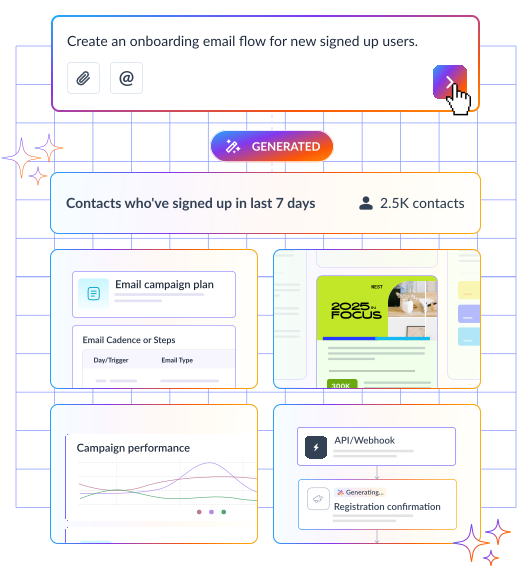
We asked Mailmodo AI to generate an entire campaign plan for churned customer email sequence and it delivered a detailed, actionable plan that we could review, customize, and turn into an automated workflow instantly. The output also outlined what emails to send, when to send them, and what each message should achieve.
Take a look at the prompt we used. Click on the arrow to see the output we received.
Create a churned customer email campaign plan for a fintech product. Include objectives, number of emails, email themes, ideal timing between emails, and the primary goal of each email.
Step 2: Create audience segments
Segmentation ensures that only genuinely churned users receive this sequence. Sending these emails to active users can damage trust. You can segment users based on:
- Last app activity date
- Last transaction date
- Account status (active, dormant, closed)
- Product type used (payments, savings, investments)
- Subscription or plan status
We used Mailmodo AI to create an audience segment of users who had no logins or transactions in the last 60–90 days and were previously active. Once it was done, we got the option to review, make edits using the builder, or ask AI to carry out the changes we wanted. Once we confirmed, Mailmodo AI created the segment instantly and it was ready to use for a campaign.
Take a look at the prompt we used, along with the output we got.
Create a dynamic segment of fintech users who have not logged in or made any transactions in the last 60 to 90 days and are marked as churned.
Step 3: Create the email templates
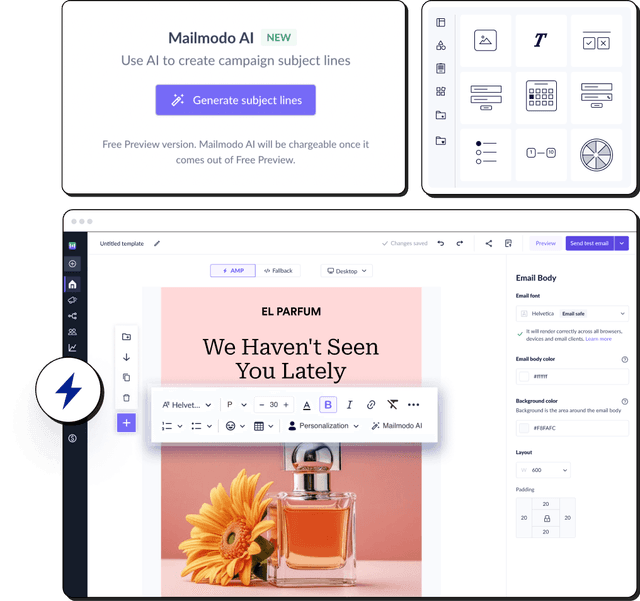
Once the audience is ready, the next step is designing the emails themselves. Here’s a sample list of emails that you should be creating for your price drop email sequence. We’ve also included sample prompts that you can use in Mailmodo AI to generate these email templates in minutes instead of having to spend hours creating them.
Email #1: Feedback email
When to send: Immediately after the user is marked as churned
Purpose: Understand why the user stopped using the product
What to include:
- A clear acknowledgment that they’ve been inactive
- A short explanation of why their feedback matters
- One primary question about why they stopped using the product
- An optional open-ended feedback field
- A reassuring, non-sales tone
Here’s a sample prompt to generate this kind of email, along with the output it will produce.
Generate a feedback email for churned fintech customers. Ask why they stopped using the product and about their overall experience. Keep the tone empathetic, neutral, and non-promotional.
Email #2: Keep in touch
When to send: 3 days after the feedback email
Purpose: Maintain a light connection for future re-engagement
What to include:
- Appreciation for their time, even if they didn’t respond
- A brief note on how feedback is used to improve the product
- What type of updates they might hear from you in the future
- A reassurance that emails will be occasional and relevant
Here’s a sample prompt to generate this kind of email, along with the output it will produce.
Generate a keep-in-touch email for churned fintech customers. Explain how feedback is implemented and set expectations for occasional product or company updates.
Step 4: Build the automated workflow
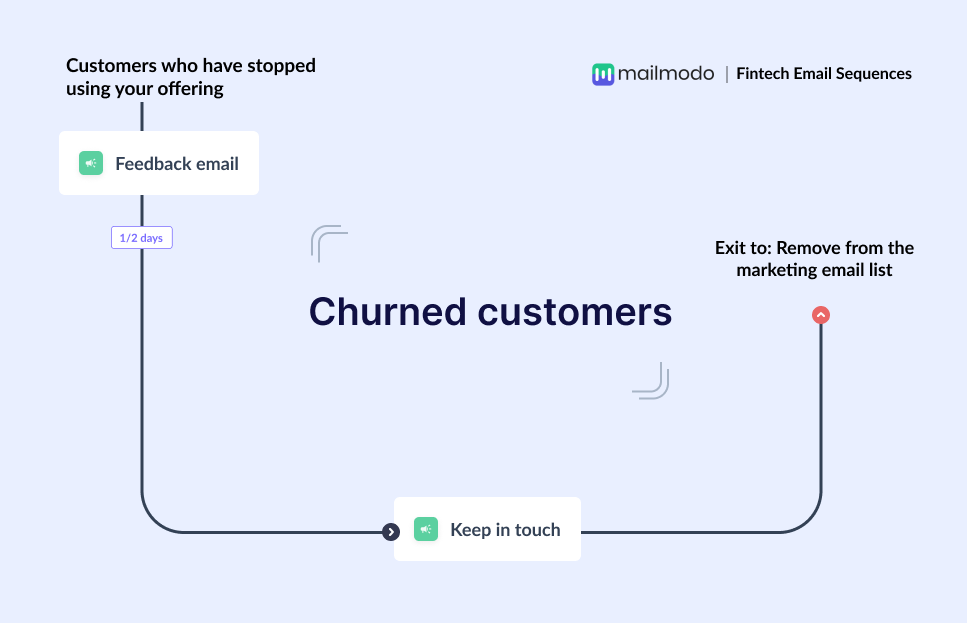
Once your emails are ready, the next step is to automate them so your users receive them at the right moment. Automation ensures the sequence runs consistently without manual effort. Your churned customer email flow should include:
- Trigger: User becomes inactive for 60–90 days
- Delays: 0 days → 3 days
- Branching logic: None required
- Exit criteria: User becomes active
We used Mailmodo AI to generate the entire workflow, including triggers and timing. Once the output was ready, we just had to review the overall journey following a setup checklist and ask the AI to make the tweaks we wanted in the workflow.
Take a look at the prompt that we used and the output we received.
Generate a complete automated workflow for a fintech churned customer email sequence. Include triggers, delays, and exit criteria.
Step 5: Analyze and improve
Even though this sequence isn’t designed for immediate conversion, performance still matters. The right insights help improve future retention efforts. Key metrics to track include:
- Open rate
- Feedback submission rate
- Response quality
- Unsubscribe rate
- Spam complaints
You can also ask Mailmodo AI to analyze the performance of your email sequence and suggest optimizations based on engagement and conversion data. Here’s a sample prompt that you can use for this:
Analyze my churned customer email sequence for a fintech product. Recommend improvements to increase open rates and feedback responses.
Conclusion
A well-structured churned customer email sequence helps you understand why users leave and keeps your brand top of mind for the future. When combined with the right segmentation and timing, even a short two-email flow can create long-term value.
Tools like Mailmodo make it easier to plan, create, automate, and optimize these sequences without overcomplicating the process. With the right approach, churn doesn’t have to be the end of the relationship, it can be the start of a better one.


 Learn more about Mailmodo