


In fintech, trust and education are everything. Whether you’re offering a digital wallet, investment platform, lending product, or compliance solution, your audience needs clarity before they’re ready to take action.
That’s why lead magnets like ebooks, whitepapers, calculators, or checklists work so well in fintech. They help prospects understand complex topics such as risk, regulations, returns, or security before committing to a product.
But downloading a resource doesn’t automatically move someone closer to becoming a customer. Without follow-up, most leads forget why they signed up or never explore what you offer next. This is where a well-structured lead magnet email flow becomes essential.
In this guide, we’ll walk through how to build a complete fintech lead magnet email sequence from scratch.
Why should you use an email flow?
Email is one of the most effective channels for nurturing fintech leads after a lead magnet download. Unlike ads or social posts, email gives you a direct, permission-based line to people who’ve already shown interest. For fintech businesses, email works especially well because it allows you to:
- Explain complex products in a structured, easy-to-digest way
- Build credibility over time through education and value
- Personalize content based on user intent, resource type, or behavior
- Automate follow-ups while staying compliant and consistent
However, a single message can deliver the resource, but it can’t build trust, explain benefits, and introduce your offerings all at once. Fintech buyers need multiple touchpoints to feel confident enough to explore or sign up.
That’s why a lead magnet email sequence—sent over a short, intentional period—is far more effective than a one-off email.
What is a lead magnet email sequence?
A lead magnet email sequence is a series of automated emails sent to users after they opt-in to receive a resource such as an ebook, whitepaper, checklist, or report.
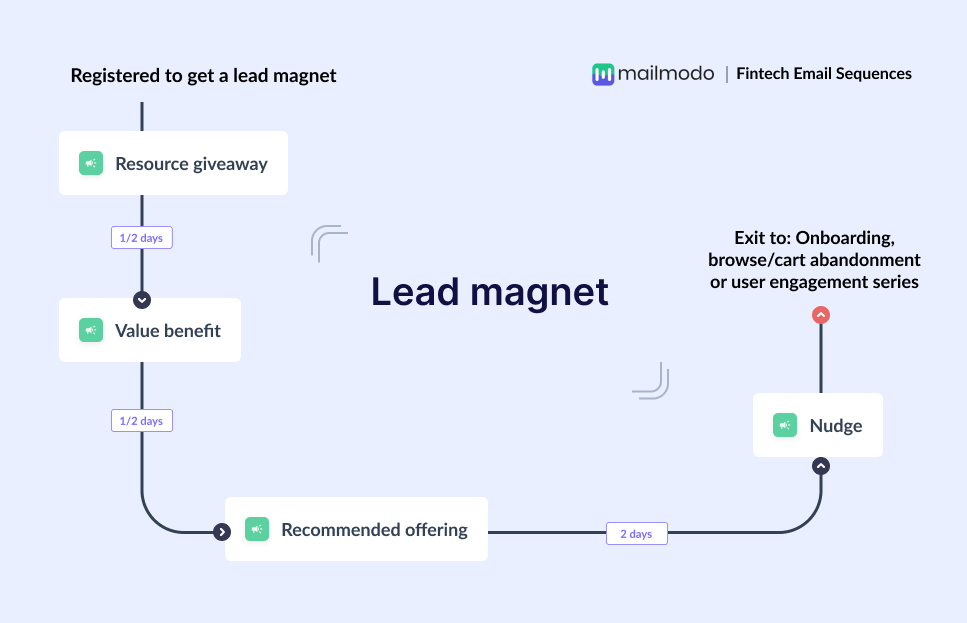
The sequence typically includes:
- A resource delivery email
- Educational or value-driven follow-ups
- Product or offering recommendations
- A final reminder or nudge
How to build a lead magnet email sequence
Building an email sequence can be easy if you’re following a well-defined set of steps. Here are the steps for you to follow:
Step 1: Plan your campaign
Before creating any emails, you need a clear plan. In fintech, this ensures your messaging stays compliant, focused, and aligned with user intent. You can start by outlining:
- Objective: Deliver the lead magnet and drive users to explore relevant fintech offerings
- Audience: Users who signed up for a specific resource (e.g., investment guide, compliance checklist)
- Core messaging: Education-first, trust-building, problem-solution focused
- Number of emails: 4 emails
- Timeline: 1 week
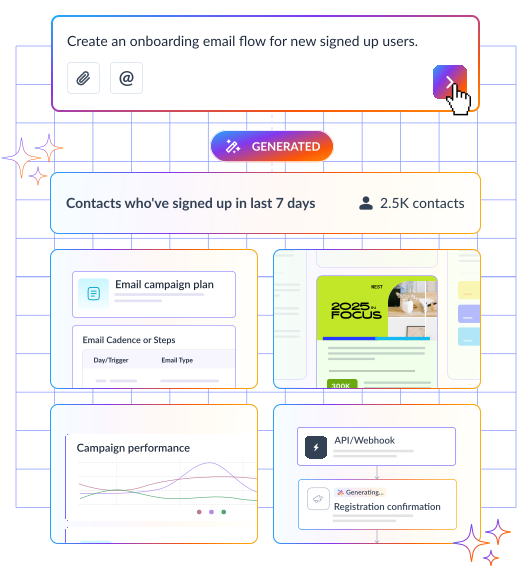
We asked Mailmodo AI to generate an entire campaign plan for a fintech lead magnet email sequence and it delivered a detailed, actionable plan that we could review, customize, and turn into an automated workflow instantly. The output also outlined what emails to send, when to send them, and what each message should achieve.
Take a look at the prompt we used. Click on the arrow to see the output we received.
Create a lead magnet email campaign plan for a fintech company. Include objectives, number of emails, theme of each email, ideal timing between emails, and the main CTA for each email.
Step 2: Create audience segments
Segmentation is especially important in fintech because users download resources for very specific reasons—compliance, investing, lending, or financial planning. Instead of sending the same follow-up to everyone, segment users based on:
- Lead magnet downloaded (ebook, whitepaper, checklist)
- Topic of interest (investing, payments, compliance, credit)
- Engagement behavior (email opens, link clicks, site visits)
- Lifecycle stage (new lead vs returning lead)
We used Mailmodo AI to quickly create an audience segment for this email sequence. Once it was done, we got the option to review, make edits using the builder, or ask AI to carry out the changes we wanted. Once we confirmed, Mailmodo AI created the segment instantly and it was ready to use for a campaign.
Take a look at the prompt we used, along with the output we got.
Create a dynamic segment of fintech leads who downloaded a lead magnet in the last 7 days and have not yet started onboarding or received a product marketing email.
Step 3: Create the email templates
Once segmentation is in place, the next step is creating the emails that make up the sequence. Here’s a sample list of emails that you should be creating for your price drop email sequence. We’ve also included sample prompts that you can use in Mailmodo AI to generate these email templates in minutes instead of having to spend hours creating them.
Email #1: Resource giveaway
When to send: Immediately after resource download
Purpose: Deliver the promised resource and set expectations
What to include:
- Direct access to the lead magnet
- A short explanation of what the resource covers
- How it will help solve a specific fintech problem
- A brief note on what they’ll receive next
Here’s a sample prompt to generate this kind of email, along with the output it will produce.
Generate a fintech lead magnet delivery email. Include a clear link to download the resource, explain its value, and set expectations for upcoming emails in the series.
Email #2: Value benefit
When to send: 1–2 days after Email #1
Purpose: Connect the lead magnet topic to the user’s pain points
What to include:
Key insights or takeaways from the resource
A common fintech challenge the user faces
How your solution helps address that challenge
A soft introduction to relevant offerings
Here’s a sample prompt to generate this kind of email, along with the output it will produce.
Generate a fintech value-based follow-up email. Explain how the topic of the lead magnet relates to a common pain point and introduce a relevant solution without a hard pitch.
Email #3: Recommended offering
When to send: 2–3 days after Email #2
Purpose: Introduce relevant fintech products or features
What to include:
- One primary offering tied closely to the lead magnet topic
- Optional secondary offerings they may find useful
- Clear benefits instead of feature-heavy explanations
- Social proof or credibility signals, if applicable
Here’s a sample prompt to generate this kind of email, along with the output it will produce.
Create a fintech product recommendation email based on a lead magnet topic. Highlight one primary offering, explain its benefits, and include one secondary recommendation that adds value.
Email #4: Nudge
When to send: 1–2 days after Email #3
Purpose: Encourage action
What to include:
- A reminder of the value they’ve seen so far
- A clear next step (sign up, book a demo, explore features)
- Light urgency or reassurance
- An easy way to take action
Here’s a sample prompt to generate this kind of email, along with the output it will produce.
Generate a fintech nudge email encouraging users to take the next step. Keep the tone supportive, clear, and focused on value rather than urgency.
Step 4: Build the automated workflow
With templates ready, the next step is stitching everything together. An automated workflow ensures the right message reaches the right user at the right time without any manual intervention. You lead magnet email sequence should include:
- Trigger: User signs up for a fintech lead magnet
- Delays: Immediate → 1–2 days → 2–3 days → 1–2 days
- Branching logic: If user clicks or signs up → move to onboarding; If inactive → continue the nurture sequence
- Exit criteria: User enters onboarding or adoption flow
We used Mailmodo AI to generate the full automated workflow from scratch. It mapped the triggers, delays, conditions, and exits. Once the output was ready, we just had to review the overall journey following a setup checklist and ask the AI to make the tweaks we wanted in the workflow.
Take a look at the prompt that we used and the output we received.
Generate a complete automated workflow for a fintech lead magnet email sequence. Include triggers, delays, branching logic based on engagement, and exit criteria.
Step 5: Analyze and improve
Once the sequence is live, optimization becomes key. In fintech, small improvements in clarity or timing can significantly impact engagement. Some important metrics for you to track include:
- Open rate
- Click-through rate
- Resource download completion
- Product page visits
- Sign-ups or demo requests
- Drop-off points within the sequence
You can also ask Mailmodo AI to analyze the performance of your email sequence and suggest optimizations based on engagement and conversion data. Here’s a sample prompt that you can use for this:
Analyze my fintech lead magnet email sequence performance. Identify drop-offs, engagement issues, and suggest improvements to increase clicks and product sign-ups.
Conclusion
A structured lead magnet email flow helps you educate users, build trust, and guide them toward the right offerings without rushing the process.
By combining clear planning, smart segmentation, purposeful emails, and automation, you can turn simple resource downloads into meaningful product conversations.
Mailmodo makes this process easier by helping you plan, create, automate, and optimize your lead magnet email sequences with AI, so you can focus on delivering value while the system does the heavy lifting.


 Learn more about Mailmodo