

In the fintech industry, events like webinars, virtual summits, product demos, and compliance workshops play a critical role in educating prospects and building trust. Whether you’re selling a payments platform, lending solution, neobank product, or compliance software, events help you start meaningful conversations with a highly relevant audience.
But the real challenge begins after the event ends. Attendees may have shown interest, asked questions, or downloaded resources, yet many won’t take the next step on their own. Long decision cycles, risk concerns, and internal approvals can slow down conversions.
That’s where a post-event nurture email sequence becomes essential. It helps you stay top of mind, reinforce your value, and guide attendees toward trying or adopting your product while their interest is still fresh. In this guide, we’ll walk through how to build a complete fintech post-event nurture email sequence.
Why should you use an email flow?
Email works exceptionally well for post-event nurturing in fintech because it allows you to follow up in a compliant, controlled, and personalized way. Unlike ads or social posts, email gives you direct access to attendees who have already opted in and engaged with your brand.
With email, you can tailor messages based on event behavior such as session attended, questions asked, or resources downloaded. This is especially important in fintech, where different segments care about different pain points like security, compliance, scalability, or cost efficiency.
But one follow-up email is rarely enough. Attendees need multiple touchpoints to process information, evaluate risk, and build confidence before trying a financial product. A well-timed sequence helps you educate, reassure, and nudge them toward action over several days instead of overwhelming them all at once.
What is a post-event nurture email sequence?
A post-event nurture email sequence is a series of automated emails sent to event attendees after an event to educate them further, address their pain points, and encourage them to take the next step with your product or service.
In a fintech context, this sequence often includes:
- Event follow-ups
- Educational content
- Product use cases
- Incentives
- Action nudges
The goal is to move attendees from interest to intent while maintaining trust and relevance.
How to build a post-event nurture email sequence
Building an email sequence can be easy if you’re following a well-defined set of steps. Here are the steps for you to follow:
Step 1: Plan your campaign
Planning sets the foundation for an effective post-event nurture sequence. In fintech, clarity is critical because your messaging needs to balance education, trust, and conversion. You can start by outlining the core elements of your campaign:
- Objectives: Trial sign-ups, demo bookings, product exploration, or onboarding
- Audience: Event attendees, no-shows, high-intent participants
- Messaging: Pain-point driven, educational, trust-focused
- Number of emails: 3–4 emails
- Timeline: Spread over 5–7 days
We asked Mailmodo AI to generate an entire campaign plan for a price drop email sequence and it delivered a detailed, actionable plan that we could review, customize, and turn into an automated workflow instantly. The output also outlined what emails to send, when to send them, and what each message should achieve.
Execution-wise, align your messaging with the event topic. If the event focused on fraud prevention, your emails should expand on security, compliance, and real-world examples. Keep each email focused on one clear outcome.
Take a look at the prompt we used. Click on the arrow to see the output we received.
Create a post-event nurture campaign plan for a fintech company. Include campaign objectives, target audience, number of emails, key message for each email, ideal timing, and the main CTA.
Step 2: Create audience segments
Segmentation is especially powerful for fintech post-event nurture because not all attendees have the same intent or maturity level. You can segment your audience based on:
- Event attendance (attended vs. registered but didn’t attend)
- Engagement level (asked questions, downloaded resources)
- Job role (founders, finance leaders, compliance teams)
- Product interest (payments, lending, APIs, security)
For this sequence, we use Mailmodo AI to create a segment of attendees who either joined the event live or interacted with at least one event-related resource within the last 7 days. Once it was done, we got the option to review, make edits using the builder, or ask AI to carry out the changes we wanted. Once we confirmed, Mailmodo AI created the segment instantly and it was ready to use for a campaign.
Take a look at the prompt we used, along with the output we got.
Create a dynamic segment of fintech event attendees who either attended the event or clicked on at least one event-related email or resource in the last 7 days.
Step 3: Create the email templates
Once segmentation is ready, the next step is designing the actual emails that will move attendees closer to action. Here’s a sample list of emails that you should be creating for your post-event nurture email sequence. We’ve also included sample prompts that you can use in Mailmodo AI to generate these email templates in minutes instead of having to spend hours creating them.
Email #1: Event follow-up
When to send: Within 24 hours after the event
Purpose: Re-engage attendees and reinforce event value
What to include:
- Event recording or key takeaways
- Slides or additional learning resources
- Related webinars or upcoming events
- Soft introduction to your product
Here’s a sample prompt to generate this kind of email, along with the output it will produce.
Generate a post-event follow-up email for a fintech audience. Include a short thank-you note, a link to the event recording, 2–3 key takeaways, and a soft CTA to explore our fintech product.
Email #2: Solve a pain point
When to send: 2–3 days after Email #1
Purpose: Connect attendee pain points to your solution
What to include:
- A specific fintech challenge discussed in the event
- How your product addresses this challenge
- Use cases or short customer examples
- Educational CTA (product page, explainer, case study)
Here’s a sample prompt to generate this kind of email, along with the output it will produce.
Generate a fintech post event email that focuses on a key pain point discussed during the event. Explain the problem, show how our product helps solve it, and include an educational CTA to learn more.
Email #3: Nudge action
When to send: 2–3 days after Email #2
Purpose: Encourage product trial or direct engagement
What to include:
- Limited-time incentive or exclusive offer
- Clear next step (demo, free trial, consultation)
- Reassurance around security, compliance, or ease of use
Here’s a sample prompt to generate this kind of email, along with the output it will produce.
Generate a fintech post-event email that nudges users to take action. Include an exclusive offer, a strong CTA to book a demo or start a trial, and reassurance around security and compliance.
Step 4: Build the automated workflow
Once your emails are ready, the next step is to automate them so every new user receives them at the right moment. Your post-event nurture email sequence should include:
- Trigger: User attends an event or engages with event content
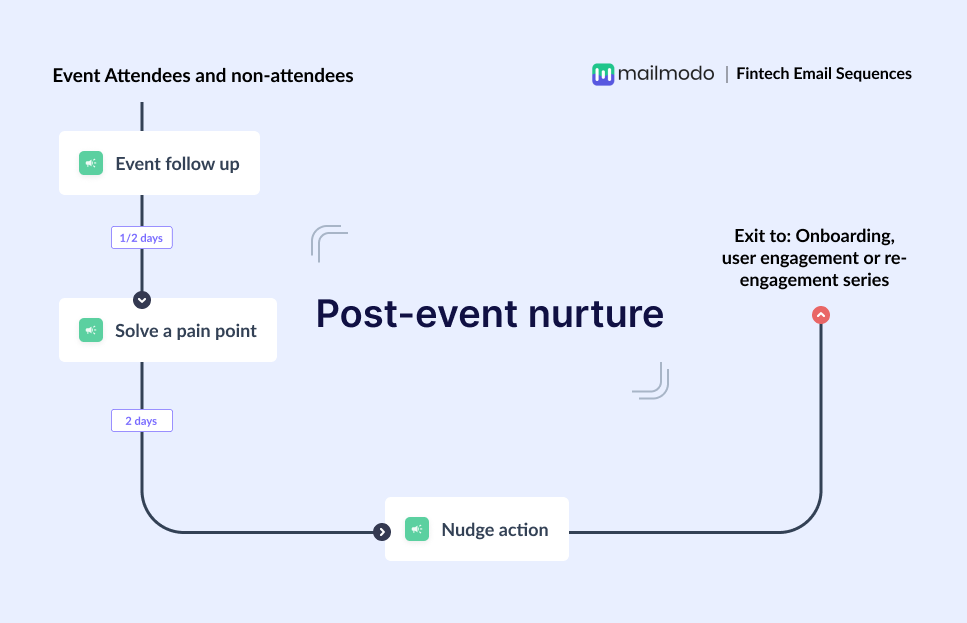
- Delays: 0 days → 2 days → 2–3 days
- Branching logic: If user clicks product link → move to onboarding flow; If user is inactive → send the next email
- Exit criteria: User signs up, books a demo, or enters onboarding
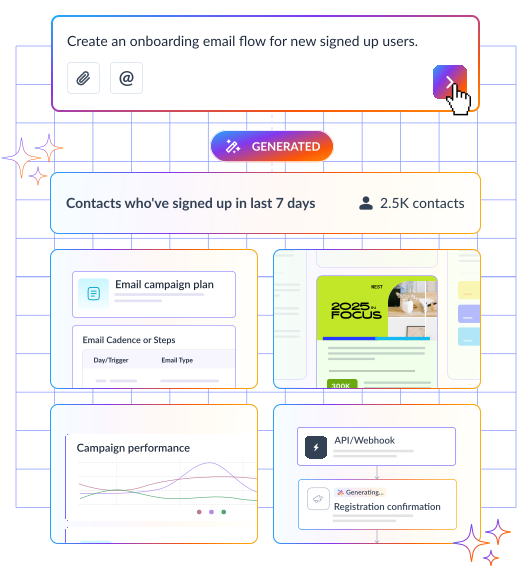
We used Mailmodo AI to generate this full workflow from scratch. It mapped the triggers, delays, conditions, and exits. Once the output was ready, we just had to review the overall journey following a setup checklist and ask the AI to make the tweaks we wanted in the workflow.
Take a look at the prompt that we used and the output we received.
Generate a complete automated post-event nurture workflow for a fintech product. Include triggers, delays, branching logic, and exit conditions.
Step 5: Analyze and improve
Analysis helps you understand what’s working and where attendees drop off. In fintech, small improvements can significantly impact conversions. Key metrics for you to track include:
- Open rate
- Click-through rate
- Resource engagement
- Demo or trial sign-ups
- Drop-off points in the sequence
You can also ask Mailmodo AI to analyze the performance of your email sequence and suggest optimizations based on engagement and conversion data. Here’s a sample prompt that you can use for this:
Analyze my fintech post-event nurture email sequence and suggest improvements to increase engagement and product sign-ups.
Conclusion
Post-event nurturing is especially important in fintech, where trust, education, and timing heavily influence buying decisions. A structured email sequence helps you stay relevant, address real concerns, and guide attendees toward meaningful action.
By combining email sequencing with smart automation, you can turn event interest into product adoption without overwhelming your audience. Tools like Mailmodo make it easier to plan, create, automate, and optimize post-event nurture sequences, all in one place.


 Learn more about Mailmodo