

User attention is fragile and short. Customers sign up with strong intent, but if they don’t see immediate value, they often stop transacting or engaging. This inactivity can quietly turn into churn before you even realize there’s a problem.
Re-engagement becomes critical here. Whether it’s a trading app, digital wallet, lending platform, or neobank, inactive users mean lost revenue, lower lifetime value, and wasted acquisition spend. The challenge isn’t just getting users back; it’s doing it in a way that feels relevant, timely, and helpful rather than pushy.
This is where a well-structured re-engagement email sequence helps. Instead of one-off reminders, a thoughtfully designed flow can educate users, rebuild trust, and guide them back to meaningful actions. In this guide, we’ll walk through how to build a complete fintech re-engagement email sequence.
Why should you use an email flow?
Email works especially well for re-engagement in fintech because it offers a direct and trusted line of communication. Users may ignore ads or push notifications, but emails allow you to deliver context-rich messages that explain value, updates, and next steps clearly.
Fintech users often disengage due to uncertainty, lack of understanding, or simply forgetting about the product. Email lets you personalize messaging based on past behavior, transaction history, or inactivity period, making every touchpoint feel intentional rather than generic.
Re-engagement also requires multiple nudges. One email may spark curiosity, but it rarely drives action on its own. A sequence allows you to combine reminders, education, social proof, and feedback collection over time, increasing the chances of bringing users back without overwhelming them.
What is a re-engagement email sequence?
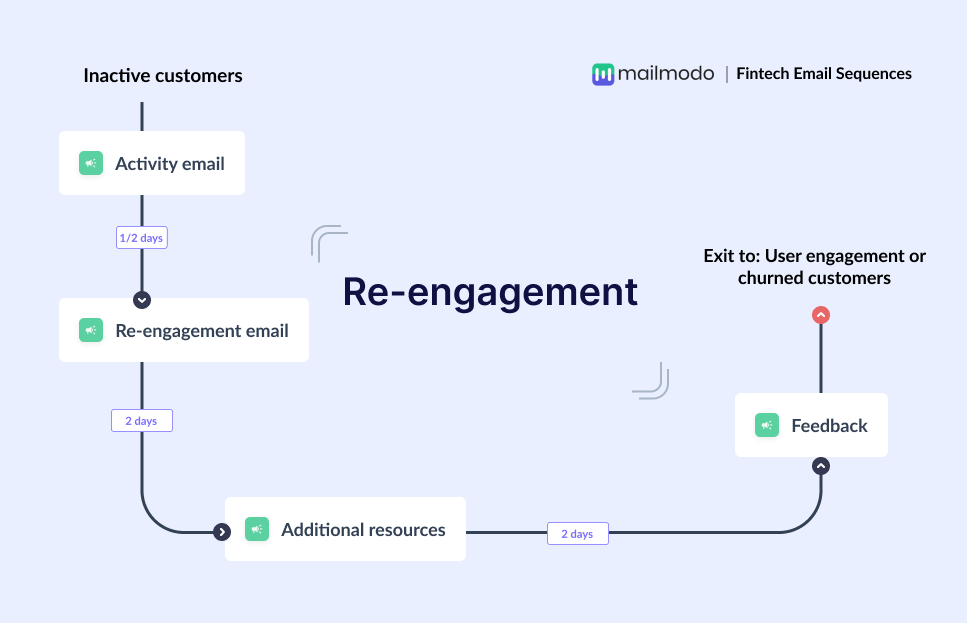
A re-engagement email sequence is a series of automated emails sent to inactive users to encourage them to return, interact, or transact on a platform again.
In fintech, this sequence typically includes activity reminders, value-driven updates, educational resources, and feedback requests. Each email builds on the previous one, gradually guiding the user back toward meaningful engagement.
How to build a re-engagement email sequence
Building an email sequence can be easy if you’re following a well-defined set of steps. Here are the steps for you to follow:
Step 1: Plan your campaign
Planning sets the direction for the entire re-engagement flow. In fintech, where trust and clarity matter, the campaign plan ensures every message serves a clear purpose instead of sounding repetitive or desperate.
Start by outlining what success looks like and how you’ll measure it. Your plan should clearly define:
- Objective: Reactivate inactive users and reduce churn
- Audience: Users inactive for a defined period (e.g., 14–30 days)
- Core message: Remind users of value and help them restart
- Number of emails: 4
- Timeline: 1 week, repeated monthly based on inactivity
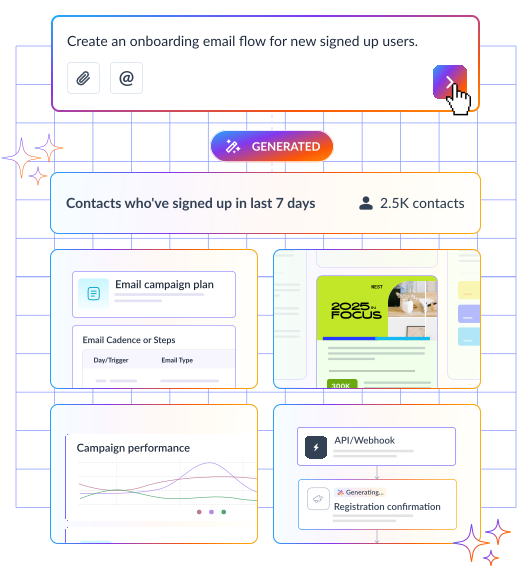
To speed this up, we used Mailmodo AI to generate a complete re-engagement campaign plan. It helped us define the number of emails, their purpose, and ideal spacing between them. The AI output gave us a clear structure that we could quickly refine and use.
Take a look at the prompt we used. Click on the arrow to see the output we received.
Create a re-engagement campaign plan for a fintech product. Include campaign objectives, target audience, number of emails, the goal of each email, and ideal timing between emails.
Step 2: Create audience segments
Segmentation is crucial for fintech re-engagement because not all inactive users are the same. Some may have completed onboarding but stopped transacting, while others never got past the first step. Segment users based on behavior, lifecycle stage, and engagement signals such as:
- Last transaction date
- App or platform login activity
- Past feature usage
- Account type or product interest
- Time since last engagement
For this sequence, we created a segment of users who signed up and showed initial interest but haven’t performed any key action in the last 21 days. Once it was done, we got the option to review, make edits using the builder, or ask AI to carry out the changes we wanted. Once we confirmed, Mailmodo AI created the segment instantly and it was ready to use for a campaign.
Take a look at the prompt we used, along with the output we got.
Create a dynamic segment of fintech users who signed up, showed initial engagement, but have not logged in or completed any transaction in the last 21 days.
Step 3: Create the email templates
Once the audience is ready, the next step is crafting the individual emails that you’ll be sending. Here’s a sample list of emails that you should be creating for your re-engagement email sequence. We’ve also included sample prompts that you can use in Mailmodo AI to generate these email templates in minutes instead of having to spend hours creating them.
Email #1: Activity email
When to send: Day 1 of inactivity flow
Purpose: Acknowledge inactivity and reopen the conversation
What to include:
- Friendly reminder that it’s been a while
- Reassurance that getting started again is easy
- A simple CTA to return to the platform
Here’s a sample prompt to generate this kind of email, along with the output it will produce.
Generate a fintech re-engagement email that reminds users they haven’t been active recently and encourages them to return to the platform with a friendly tone.
Email #2: Re-engagement email
When to send: 2 days after Email #1
Purpose: Spark interest and motivate action
What to include:
- Market insights, updates, or timely trends
- Offers or feature highlights
- Clear CTA to transact or explore
Here’s a sample prompt to generate this kind of email, along with the output it will produce.
Create a re-engagement email for a fintech app that shares market updates or useful insights and encourages users to take action on the platform.
Email #3: Additional resources
When to send: 2 days after Email #2
Purpose: Educate and reduce friction
What to include:
- Help articles or guides
- Educational content like ebooks or tutorials
- Resources addressing common pain points
Here’s a sample prompt to generate this kind of email, along with the output it will produce.
Generate an educational fintech email that shares helpful resources, guides, or articles to help inactive users understand and use the product better.
Email #4: Feedback
When to send: 2–3 days after Email #3
Purpose: Learn why users are disengaged
What to include:
- Short feedback or survey request
- Open-ended question about their experience
- Optional support or customer success contact
Here’s a sample prompt to generate this kind of email, along with the output it will produce.
Create a feedback email for inactive fintech users asking why they haven’t been active and what can be improved to enhance their experience.
Step 4: Build the automated workflow
Automation ties the entire sequence together and ensures users receive the right message at the right time. A typical fintech re-engagement workflow looks like this:
- Trigger: User inactive for 21 days
- Delays: 0 days → 2 days → 2 days → 2–3 days
- Branching logic: If user becomes active → exit sequence; If still inactive → continue next email
- Exit criteria: User completes a key action or is marked churned
We used Mailmodo AI to generate a complete automated workflow from scratch. It mapped triggers, delays, and conditions clearly, making it easy to visualize the entire re-engagement journey and adjust logic where needed. Once the output was ready, we just had to review the overall journey following a setup checklist and ask the AI to make the tweaks we wanted in the workflow.
Take a look at the prompt that we used and the output we received.
Generate an automated re-engagement workflow for a fintech product. Include triggers, delays, branching logic based on user activity, and exit conditions.
Step 5: Analyze and improve
Re-engagement is an ongoing process, not a one-time setup. Tracking performance helps you understand what’s working and where users drop off. Key metrics for you to monitor include:
- Open rates
- Click-through rates
- Reactivation rate
- Conversion or transaction rate
- Feedback responses
You can also ask Mailmodo AI to analyze the performance of your email sequence and suggest optimizations based on engagement and conversion data. Here’s a sample prompt that you can use for this:
Analyze my fintech re-engagement email sequence and recommend improvements to increase opens, clicks, and user reactivation.
Conclusion
In fintech, user inactivity doesn’t always mean loss of interest. It often means uncertainty or lack of guidance. A structured re-engagement email sequence helps bridge that gap by reminding users of value, educating them, and inviting them back at the right moment.
With tools like Mailmodo, teams can simplify planning, segmentation, automation, and optimization without adding operational complexity. A thoughtful re-engagement flow can turn silent users into active customers again and set the foundation for long-term retention.


 Learn more about Mailmodo