


Whether you’re offering digital payments, lending, investing, or neobanking services, customers are far more likely to sign up when the recommendation comes from someone they already know.
Existing users understand your product, have experienced its value, and can confidently recommend it to friends, family, or colleagues. But simply launching a referral program isn’t enough. Many fintech teams struggle with low referral participation, poor follow-through, or unclear rewards.
This is where a well-timed referral email sequence makes a real difference. Instead of relying on a single announcement, a structured email flow nudges users, reminds them, and rewards them at the right moments.
In this guide, we’ll walk through how to build a complete fintech referral email sequence from scratch.
Why should you use an email flow?
Email is one of the most reliable channels for running referral campaigns in fintech. Unlike push notifications or in-app banners, email gives you a direct, personal line to users who already trust your brand.
For fintech products, both decisions and referrals are rarely impulsive. Users take time to understand the reward, think about who to refer, and feel confident sharing the product. Email supports this behavior perfectly by allowing you to educate, remind, and reassure users across multiple touchpoints.
Email also enables:
- Personalization based on user activity and account status
- Behavioral segmentation to target only eligible users
- Automation that runs in the background once set up
- Timed nudges without overwhelming the user
However, a single referral email often gets ignored or forgotten. A short, well-paced sequence ensures the message is seen, acted upon, and completed, making email the ideal channel for referral campaigns.
What is a referral email sequence?
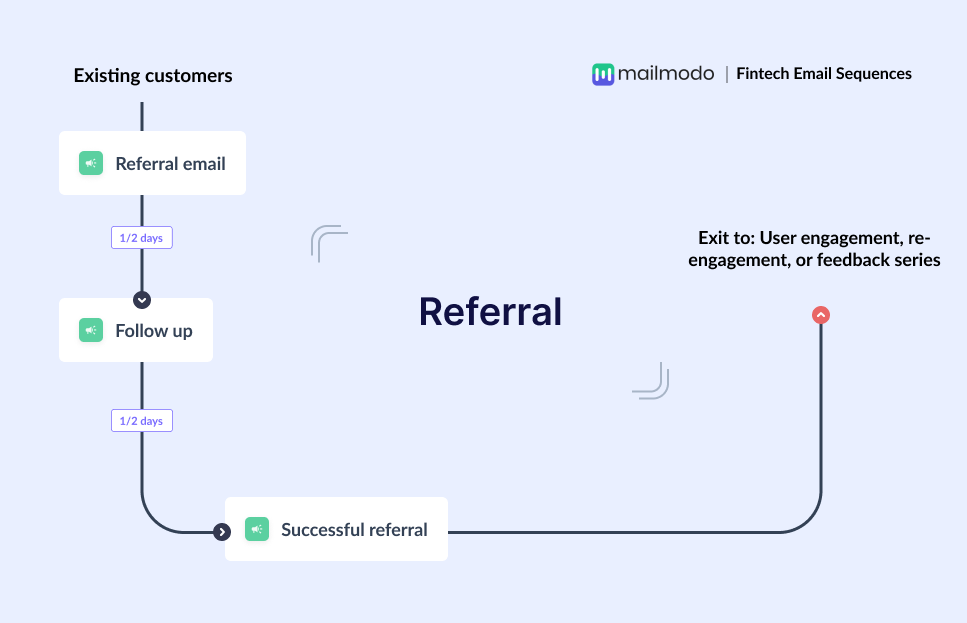
A referral email sequence is a series of automated emails sent to existing customers to encourage them to refer new users and to acknowledge successful referrals.
In fintech, this sequence typically includes:
- An initial referral invitation
- A reminder or follow-up email
- A confirmation and reward email after a successful referral
How to build a referral email sequence
Building an email sequence can be easy if you’re following a well-defined set of steps. Here are the steps for you to follow:
Step 1: Plan your campaign
Planning sets the foundation for your referral email sequence. In fintech, this step is especially important because rewards, eligibility, and compliance expectations must be clear from the start. At this stage, you define what success looks like and how the sequence will run end to end.
Your campaign plan should clearly outline:
- Objective: Increase new customer acquisition through referrals
- Audience: Active customers eligible for referral rewards
- Core message: Earn rewards by inviting trusted contacts
- Number of emails: 3
- Timeline: 4 days
- Primary CTA: Refer a friend
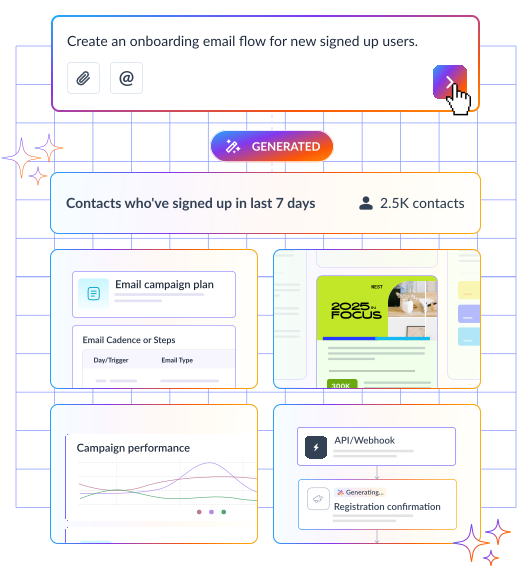
We asked Mailmodo AI to generate an entire campaign plan for a referral email sequence and it delivered a detailed, actionable plan that we could review, customize, and turn into an automated workflow instantly. The output also outlined what emails to send, when to send them, and what each message should achieve.
Take a look at the prompt we used. Click on the arrow to see the output we received.
Create a referral email campaign plan for a fintech product. Include campaign objectives, number of emails, purpose of each email, recommended timing, and primary CTA.
Step 2: Create audience segments
Not every user should receive a referral email. Segmentation ensures that only relevant, eligible customers are included, which improves engagement and protects deliverability and prevents a bad user experience.
You can segment users using attributes such as:
- Account status (active, verified, funded)
- Product usage (transactions completed, features used)
- Referral eligibility
- Engagement level (email opens, app activity)
For this sequence, we used Mailmodo AI to quickly create an audience segment of active fintech users who completed at least one transaction and had not participated in a referral campaign in the last six months.
Once it was done, we got the option to review, make edits using the builder, or ask AI to carry out the changes we wanted. Once we confirmed, Mailmodo AI created the segment instantly and it was ready to use for a campaign.
Take a look at the prompt we used, along with the output we got.
Create a dynamic segment of fintech users who are active, have completed at least one transaction, and have not sent a referral in the last 6 months.
Step 3: Create the email templates
Once your audience is defined, the next step is creating the actual emails in the sequence. Here’s a sample list of emails that you should be creating for your price drop email sequence. We’ve also included sample prompts that you can use in Mailmodo AI to generate these email templates in minutes instead of having to spend hours creating them.
Email #1: Referral email
When to send: Day 0
Purpose: Introduce the referral program and motivate users to participate
What to include:
- A clear explanation of the referral reward
- Simple steps to refer someone
- Reassurance around security and trust
- A single, focused referral CTA
Here’s a sample prompt to generate this kind of email, along with the output it will produce.
Generate a fintech referral email that explains the referral reward, how the program works, and includes a clear CTA to refer a friend.
Email #2: Follow-up reminder
When to send: Day 2
Purpose: Remind users who didn’t act on the first email
What to include:
- A short reminder about the referral reward
- Social proof or a benefit-driven nudge
- A repeated referral CTA
- Simple, scannable content
Here’s a sample prompt to generate this kind of email, along with the output it will produce.
Write a follow-up referral reminder email for a fintech product targeting users who did not refer after the first email.
Email #3: Successful referral confirmation
When to send: Immediately after a successful referral
Purpose: Confirm referral and deliver the reward
What to include:
- Confirmation of the successful referral
- Details of the reward earned
- Next steps or how to use the reward
- A positive reinforcement message
Here’s a sample prompt to generate this kind of email, along with the output it will produce.
Create a confirmation email for a successful fintech referral, including reward details and a thank-you message.
Step 4: Build the automated workflow
Once your emails are ready, the next step is to automate them so every new user receives them at the right moment. A typical fintech referral workflow includes:
Trigger: User enters referral-eligible segment
Delays: Day 0 → 2 days → conditional
Branching logic: If referral completed → send success email; If not → send follow-up reminder
Exit criteria: Referral completed or sequence ends
We used Mailmodo AI to generate a complete referral workflow from scratch. The AI mapped triggers, delays, branching conditions, and exit rules. Once the output was ready, we just had to review the overall journey following a setup checklist and ask the AI to make the tweaks we wanted in the workflow.
Take a look at the prompt that we used and the output we received.
Generate an automated workflow for a fintech referral email sequence including triggers, delays, branching logic, and exit criteria.
Step 5: Analyze and improve
Once the sequence is live, you need to perform ongoing analysis to improve performance over time. Key metrics to track include:
- Referral email open rate
- Click-through rate on referral CTAs
- Referral conversion rate
- Reward redemption rate
- Drop-off between emails
You can also ask Mailmodo AI to analyze the performance of your email sequence and suggest optimizations based on engagement and conversion data. Here’s a sample prompt that you can use for this:
Analyze my fintech referral email sequence and suggest improvements to increase referral conversions and engagement.
Conclusion
A well-planned referral email flow ensures users understand the value, get timely reminders, and feel rewarded when they succeed. When combined with automation and continuous optimization, email becomes a powerful engine for sustainable customer acquisition.
Mailmodo AI makes it easier to plan, create, automate, and improve referral email sequences, helping fintech teams turn happy customers into consistent advocates.


 Learn more about Mailmodo