


People usually deal with multiple financial commitments. These include credit card bills, loan EMIs, insurance premiums, and investment payments. These payments are often time-sensitive, and missing a due date can lead to penalties, reduced credit scores, or service disruptions.
Despite this, customers don’t always remember exact due dates or keep track of every recurring payment. A single missed reminder can result in failed payments, increased support tickets, and customer frustration.
This is where a payment reminder email sequence becomes essential for fintech companies. Instead of relying on one notification, a structured email flow keeps customers informed well in advance and nudges them at the right moments.
In this guide, we’ll walk you through how to build a complete payment reminder email sequence.
Why should you use an email flow?
Email is particularly effective for payment reminders in fintech because it combines reliability, clarity, and compliance-friendly communication.
Financial communication needs to be precise and accessible. Emails allow you to clearly share payment amounts, due dates, and account details in a format customers can revisit anytime. With personalization, you can include details like loan type, billing cycle, outstanding balance, or masked account numbers, making reminders more relevant.
Email also supports automation and timing. You can schedule reminders days before the due date, closer to the deadline, and on the due date itself. This matters because one reminder is rarely enough. Customers may miss or ignore it. Multiple touchpoints increase the chances of timely payment without sounding aggressive.
All these factors make email the most dependable channel for payment reminders in fintech.
What is a payment reminder email sequence?
A payment reminder email sequence is a set of automated emails sent to customers before and on a payment due date to remind them to complete a financial transaction.
In fintech, this sequence often includes advance notifications, follow-up reminders, and a final due-date nudge. Emails may contain payment summaries, secure payment links, confirmations, and brief explanations of what happens if a payment is missed.
How to build a payment reminder email sequence
Building an email sequence can be easy if you’re following a well-defined set of steps. Here are the steps for you to follow:
Step 1: Plan your campaign
Planning is critical for payment reminders in fintech because messaging needs to be accurate, timely, and customer-friendly. A clear plan helps you avoid confusion and ensures consistency across all reminders. Start by outlining the following:
Objective: Reduce missed or delayed payments
Target audience: Customers with upcoming payment due dates
Messaging tone: Clear, neutral, and reassuring
Number of emails: 4
Timeline: 7 days leading up to the due date
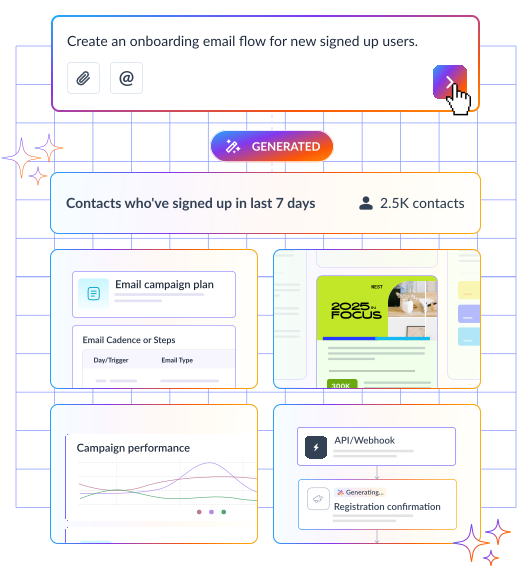
We used Mailmodo AI to create a complete campaign plan for a fintech payment reminder sequence. It delivered a detailed outline covering goals, email timing, and what each email should achieve. We reviewed the plan and customized it to match the specific requirements.
Take a look at the prompt we used. Click on the arrow to see the output we received.
Create a payment reminder email campaign plan for a fintech company. Include objectives, number of emails, timing, and the purpose of each email.
Step 2: Create audience segments
Segmentation is especially important in fintech because not all users have the same payment behavior or obligations. Sending reminders only to relevant customers improves trust and engagement. You can segment users based on:
- Payment due date
- Payment status (pending, failed, completed)
- Product type (loan, credit card, insurance, investment)
- Payment method (auto-debit vs manual)
- Outstanding amount
We used Mailmodo AI to quickly create an audience segment for this email sequence. Once it was done, we got the option to review, make edits using the builder, or ask AI to carry out the changes we wanted. Once we confirmed, Mailmodo AI created the segment instantly and it was ready to use for a campaign.
Take a look at the prompt we used, along with the output we got.
Create a dynamic segment of fintech users whose payment due date is within the next 7 days and whose payment status is pending.
Step 3: Create the email templates
Once segmentation is ready, the next step is creating the emails that will be sent as part of the sequence. Here’s a sample list of emails that you should be creating for your payment reminder email sequence. We’ve also included sample prompts that you can use in Mailmodo AI to generate these email templates in minutes instead of having to spend hours creating them.
Email #1: Payment notification
When to send: 7 days before the due date
Purpose: Inform customers about the upcoming payment
What to include:
- Payment due date
- Amount payable
- Type of payment (loan EMI, credit card bill, etc.)
- Instructions to review or update payment details
Here’s a sample prompt to generate this kind of email, along with the output it will produce.
Generate a payment notification email for a fintech product. Include due date, amount, payment type, and a clear, informative tone.
Email #2: Reminder email
When to send: 5 days before the due date
Purpose: Avoid payment failure
What to include:
- Reminder of upcoming payment
- Total amount due
- Secure payment link
- Note on maintaining sufficient balance for auto-debit
Here’s a sample prompt to generate this kind of email, along with the output it will produce.
Generate a fintech payment reminder email to be sent 5 days before the due date. Include the amount due and secure payment instructions.
Email #3: Follow-up Reminder email
When to send: 1 day before the due date
Purpose: Reach customers who missed earlier reminders
What to include:
- Urgent reminder of next-day payment
- Summary of payment details
- Support contact details for payment issues
Here’s a sample prompt to generate this kind of email, along with the output it will produce.
Generate a payment reminder email for fintech users to be sent 1 day before the due date. Use a polite but urgent tone and summarize payment details.
Email #4: Final nudge
When to send: On the due date
Purpose: Prompt immediate action
What to include:
- Payment due today message
- Clear steps to complete payment
- Brief explanation of the consequences of non-payment
Here’s a sample prompt to generate this kind of email, along with the output it will produce.
Generate a final payment reminder email for a fintech product to be sent on the due date. Include urgency, payment steps, and consequences of missing the payment.
Step 4: Build the automated workflow
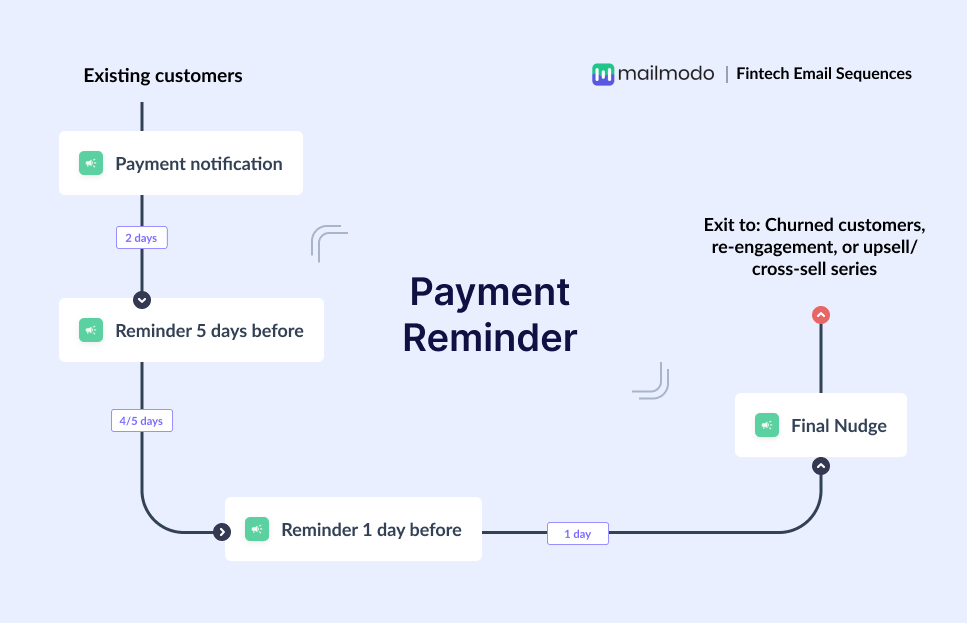
Once your emails are ready, the next step is to automate them so every new user receives them at the right moment. A typical fintech payment reminder workflow includes:
- Trigger: Payment due date is 7 days away
- Delays: 2 days → 4 days → 1 day
- Branching logic: If payment completed → exit workflow; If payment pending → continue reminders
- Exit criteria: Payment successful or account status changes
We used Mailmodo AI to generate the full automated workflow from scratch. It mapped triggers, delays, conditions, and exits. Once the output was ready, we just had to review the overall journey following a setup checklist and ask the AI to make the tweaks we wanted in the workflow.
Take a look at the prompt that we used and the output we received.
Generate a complete automated workflow for a fintech payment reminder email sequence. Include triggers, delays, conditions, and exit criteria.
Step 5: Analyze and improve
Fintech payment reminders are highly performance-driven, so regular analysis is key to improving results. Important metrics to track include:
- Email open rates
- Click-through rates on payment links
- Payment success rate
- Time taken to complete payment
- Drop-off after each reminder
You can also ask Mailmodo AI to analyze the performance of your email sequence and suggest optimizations based on engagement and conversion data. Here’s a sample prompt that you can use for this:
Analyze my fintech payment reminder email sequence and suggest improvements to increase on-time payment rates.
Conclusion
In the fintech industry, timely payments are critical for both customers and businesses. A missed payment can damage trust, disrupt services, and increase operational overhead.
With tools like Mailmodo, fintech teams can simplify planning, creation, automation, and optimization of payment reminder sequences—ensuring smoother payments and better customer experiences.


 Learn more about Mailmodo