



It’s a common story in the SaaS industry: leads often show early interest by downloading a resource, joining a webinar, or even speaking with sales, only to go quiet afterward.
Re-engaging these leads matters because they’ve already shown intent. They know your brand, they’ve interacted with your content, and many were once close to exploring your product more deeply. Without consistent follow-up, they forget about your solution and lose momentum in their evaluation journey.
Email becomes a natural channel here. It allows you to nurture these sleeping leads at scale, deliver content that rebuilds trust, and gradually move them back toward product interest.
This guide walks you through building a complete SaaS lead re-engagement email sequence from planning your campaign to creating templates and setting up the full automated workflow.
Why you should use email flows for lead re-engagement
Email is uniquely effective for re-engaging SaaS leads because it gives you the ability to reach people directly, without relying on ads or hoping they revisit your website on their own.
It also makes it easy to personalize your outreach based on earlier interactions—like the webinar they attended or the feature they showed interest in. This level of relevance can be hard to achieve through other channels.
Another advantage is automation. You can set up a recurring, evergreen re-engagement sequence that activates every quarter or every two months, ensuring no lead stays cold for long.
What is a lead re-engagement email sequence?
A lead re-engagement email sequence is a series of automated emails designed to reconnect with leads who previously interacted with your SaaS product or content but stopped engaging before taking meaningful action. These emails help refresh your brand in their mind, provide new value, and guide them back into your funnel.
A typical sequence includes components such as:
Helpful educational resources
Case studies or testimonials
Product updates or feature releases
Occasional reminders or check-ins
How to build a lead re-engagement email sequence
Building a welcome email sequence can be easy if you’re following a well-defined set of steps. Here are the steps for you to follow:
Step 1: Plan your campaign
The first step is to clarify what you're trying to accomplish with your re-engagement effort. In SaaS, this usually includes goals like restoring product recall, bringing dormant MQLs back into motion, or reactivating leads who once explored your solution but never converted.
To execute this step, define:
Your audience sources (e.g., webinar attendees, demo no-shows, ebook downloaders)
The key messages you want to communicate
The number of emails (usually 2–3 for a re-engagement cycle)
The timing (e.g., quarterly or every 60–90 days)
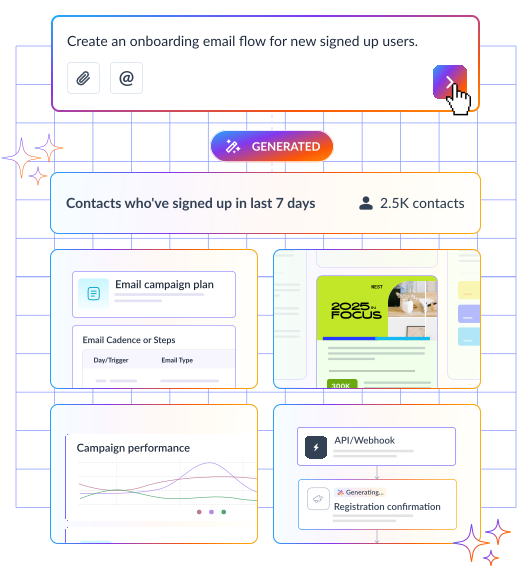
We asked Mailmodo AI to generate a complete campaign plan for a SaaS lead re-engagement sequence. It delivered a detailed plan covering goals, messaging themes, timeline, and the purpose of each email. We could review and customize it instantly before turning it into an automated sequence.
Take a look at the prompt we used. Click on the arrow to see the output we received.
Create a campaign plan for a SaaS lead re-engagement email sequence. Include goals, target audience segments, messaging themes, number of emails, and recommended timing.
Step 2: Create Audience Segments
Segmentation ensures your emails feel relevant and personalized, especially in SaaS where buyers evaluate solutions based on specific needs and use cases. Also, the leads that have gone cold may fit different criteria. They may have downloaded a resource, attended a webinar, talked to sales months ago, or simply stopped responding.
You can segment your leads by:
Behavior: webinar attended, demo booked but not attended, resource downloaded, clicked but didn’t convert
Lifecycle stage: dormant MQLs, stalled SQLs, inactive PQLs
Attributes: industry, job role, team size, use case interest
We used Mailmodo AI to create a dynamic audience segment for the re-engagement sequence. After generating the initial draft, we could refine conditions in the builder or ask AI to make adjustments. Once finalized, the segment was instantly ready for use.
Take a look at the prompt we used and the output we got.
Create a dynamic segment of all leads who engaged with our content or sales team in the last 6–12 months but did not convert.
Step 3: Create the email templates
Before writing individual emails, remember that SaaS leads typically respond best to content that educates, inspires, or reveals new product value. Each email in your sequence should do one of these things.
Email #1: Helpful Resources
When it’s sent: After a long period of inactivity (maybe a month of inactivity)
Purpose: Provide value without pitching, rebuild trust, and re-establish brand recall
What it should include:
A relevant ebook, guide, checklist, or webinar
A short explanation of why this resource matters
A single CTA to view or download the content
Here’s a sample prompt to generate this kind of email, along with the kind of email template it will produce.
Create a helpful resources email for inactive leads. Offer one high-value resource related to their past interest and include a clear CTA to view the resource.
Email #2: New case study/testimonial
When it’s sent: 3–5 days after Email #1
Purpose: Share social proof to show real customers solving similar problems
What it should include:
A short customer story tied to a core pain point
Clear before/after transformation
A CTA to read the full case study
Here’s a sample prompt to generate this kind of email, along with the kind of email template it will produce.
Generate an email template with a case-study for re-engaging cold leads. Highlight a relatable customer challenge, the solution, and measurable results. Include a CTA to read the full story.
Email #3: New feature/Product release
When it’s sent: 5–7 days after Email #2
Purpose: Show what’s new and why leads should reconsider your product
What it should include:
A short explanation of the new feature
The specific pain point the new feature solves
A CTA to explore or try the feature
Here’s a sample prompt to generate this kind of email, along with the kind of email template it will produce.
Create a SaaS product update email announcing a new feature designed to solve a key user pain point to re-engage a cold lead. Include a brief explanation, benefits, and a CTA to explore the feature.
Step 4: Build the automated workflow
Once your emails are ready, automate the entire journey so your leads receive them consistently and at the right time, without you having to handle them manually. A SaaS re-engagement sequence typically includes:
Trigger: Lead enters segment of inactive or cold leads
Delays: 0 days → 3–5 days → 5–7 days
Branching logic: If the lead re-engages → move to product nurturing or sales sequence; If still inactive → add to long-term nurture sequence
Exit criteria: Lead replies, books a demo, or signs up
We used Mailmodo AI to generate the complete workflow. It included triggers, delays, branches, and exit conditions automatically. After reviewing the flow and making small adjustments, the workflow was ready to activate.
Take a look at the prompt that we used and the output we received.
Generate a complete email flow for a SaaS lead re-engagement sequence. Include triggers, delays, conditions, branching logic, and exit criteria.
Step 5: Analyze and improve
Once your sequence is live, you need to measure how effectively it revives cold leads. Key SaaS metrics that you should track include:
Open rate: Is your subject line compelling enough?
Click rate: Are people engaging with your resource or case study?
Reactivation rate: How many leads return to your site or product?
Demo re-bookings: How many show renewed interest?
Engagement drop-off: Which email needs improvement?
We asked Mailmodo AI to analyze our last re-engagement email sequence. It summarized performance, identified weak points, and recommended improvements to increase conversions.
Take a look at the prompt that we used and the output we received.
Analyze my last re-engagement campaign and suggest improvements to increase engagement and conversions.
Conclusion
Lead re-engagement is essential in SaaS because your best opportunities are often the ones who already know you, they just need the right nudge to revisit your solution. Using email sequences ensures you stay top of mind with helpful, relevant, and timely messages.
With a structured approach and thoughtful sequencing, you can warm up dormant leads, rebuild interest, and guide them back toward your product in a natural and value-driven way.
Mailmodo makes this entire process easier, from planning and creating templates to automating workflows and analyzing results, so you can consistently re-engage leads without manual effort.


 Learn more about Mailmodo