



It’s not uncommon for ecommerce store owners to see customers add items to their cart, start the checkout process, and then leave without completing the purchase. Distractions, unexpected shipping costs, payment issues, or simple hesitation can cause shoppers to drop off at the last moment.
Instead of letting these high-intent customers slip away, an abandoned checkout email sequence gives you a second chance to bring them back. With timely reminders, helpful nudges, and the right incentives, you can recover a large portion of otherwise lost sales.
In this guide, we’ll walk through how to build a complete abandoned checkout email sequence for your ecommerce store.
Why should you use an email flow?
Email works exceptionally well for abandoned checkout recovery in ecommerce because it reaches customers directly at a moment when intent is already high.
Unlike ads or push notifications, emails allow you to show personalized cart details, address objections, and follow up at the right time without being intrusive. You can tailor messages based on cart value, product category, or past behavior, making each email feel relevant rather than generic.
A single reminder email is rarely enough. Some shoppers forget, others need reassurance, and some require an incentive or urgency to act. Multiple touchpoints over a short time window increase the chances of re-engagement while staying top of mind. That’s why a structured abandoned checkout email sequence works effectively.
What is an abandoned checkout email sequence?
An abandoned checkout email sequence is a series of automated emails sent to shoppers who start the checkout process but leave without completing their purchase.
These emails typically include reminders, cart details, incentives, urgency cues, and reassurance messages, all designed to guide the shopper back to checkout and complete the transaction.
How to build an abandoned checkout email sequence
Building an email sequence can be easy if you’re following a well-defined set of steps. Here are the steps for you to follow:
Step 1: Plan your campaign
Before writing any emails, you need a clear plan for what the sequence should achieve and how it will run. For an ecommerce abandoned checkout sequence, your plan should outline:
- Objective: Recover lost revenue and complete pending purchases
- Target audience: Shoppers who entered checkout but didn’t place an order
- Messaging: Reminder → reassurance → incentive → urgency
- Number of emails: 3–4 emails
- Timeline: Sent over 3–4 days from cart abandonment
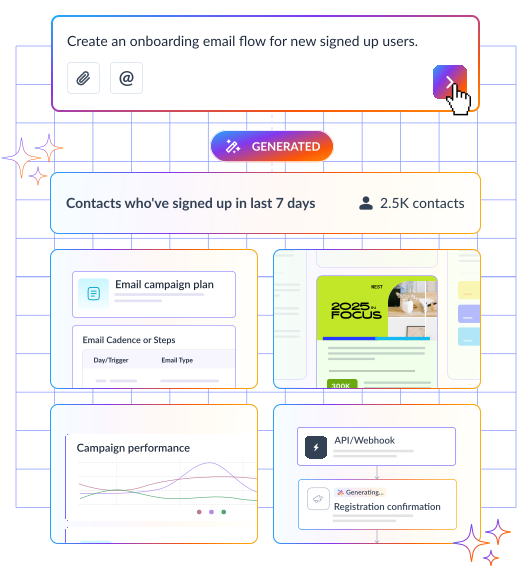
We asked Mailmodo AI to generate an entire campaign plan for an abandoned checkout flow and it delivered a detailed, actionable plan that we could review, customize, and turn into an automated workflow instantly. The output also outlined what emails to send, when to send them, and what each message should achieve.
Take a look at the prompt we used. Click on the arrow to see the output we received.
Create an abandoned checkout email campaign plan for an ecommerce brand. Include objectives, number of emails, the goal of each email, and ideal timing between emails.
Step 2: Create audience segments
Not every shopper abandons checkout for the same reason. Segmentation helps you send more relevant messages and avoid unnecessary emails. For abandoned checkout flows, segmentation can be done using:
- Checkout started but no purchase completed
- Cart value (high vs low)
- Product category in cart
- Returning vs first-time shoppers
We used Mailmodo AI to quickly create an audience segment for this email sequence. Once it was done, we got the option to review, make edits using the builder, or ask AI to carry out the changes we wanted. Once we confirmed, Mailmodo AI created the segment instantly and it was ready to use for a campaign.
Take a look at the prompt we used, along with the output we got.
Create a dynamic segment of users who started checkout but did not complete a purchase in the last 24 hours on an ecommerce store. Exclude users who have already placed an order.
Step 3: Create the email templates
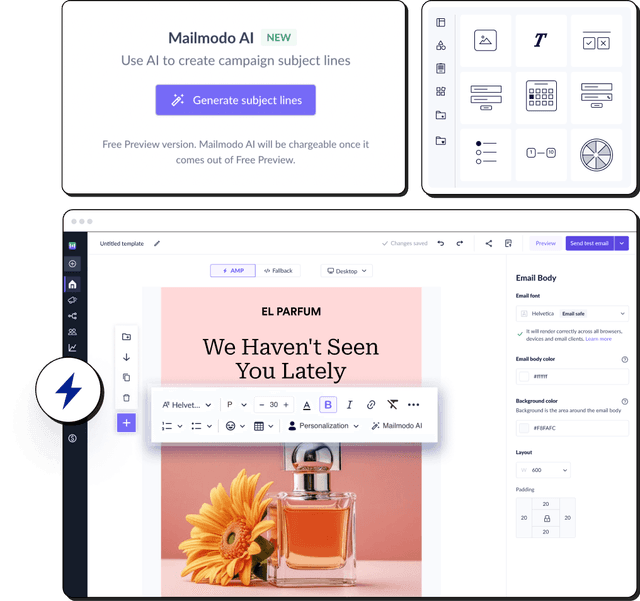
Once the audience is defined, the next step is to design emails that address different stages of hesitation. Here’s a sample list of emails that you should be creating for your abandoned checkout email sequence. We’ve also included sample prompts that you can use in Mailmodo AI to generate these email templates in minutes instead of having to spend hours creating them.
Email #1: Abandoned checkout reminder
When to send: Within 30–60 minutes of cart abandonment
Purpose: Bring the shopper back while the intent is still fresh
What to include:
- Product images and product names from the cart
- Clear reminder that checkout wasn’t completed
- Prominent “Return to checkout” button as the CTA
- Reassurance about secure payment and easy returns
Here’s a sample prompt to generate this kind of email, along with the output it will produce.
Generate an abandoned checkout email template for an ecommerce store. Include cart product details, a reminder message, and a clear CTA to return to checkout.
Email #2: Follow-up reminder
When to send: 12–24 hours after abandonment
Purpose: Nudge shoppers who may have been distracted or undecided
What to include:
- Friendly reminder
- Cart summary
- FAQs or trust signals (shipping, returns, support)
- Checkout CTA
Here’s a sample prompt to generate this kind of email, along with the output it will produce.
Generate a follow-up abandoned checkout email. Focus on reassurance, trust signals, and addressing common checkout concerns.
Email #3: Offer or incentive email
When to send: 2–3 days after abandonment
Purpose: Overcome price hesitation
What to include:
- Limited-time discount or free shipping
- Expiry timeline for the offer
- Cart reminder and CTA
Here’s a sample prompt to generate this kind of email, along with the output it will produce.
Generate an abandoned checkout email offering a limited-time discount. Include urgency, offer details, and a strong CTA to complete the purchase.
Email #4: Selling fast / FOMO email
When to send: 3-4 days after abandonment
Purpose: Create urgency as a last attempt
What to include:
- Low stock or high demand messaging
- Reminder that items may sell out
- Clear checkout CTA
Here’s a sample prompt to generate this kind of email, along with the output it will produce.
Generate a final abandoned checkout email using urgency and FOMO. Include limited stock or high-demand messaging without sounding aggressive.
Step 4: Build the automated workflow
Once your emails are ready, the next step is to automate them so every new user receives them at the right moment. A typical abandoned checkout workflow should include:
- Trigger: User starts checkout but doesn’t complete purchase
- Delays: 1 hour → 12–24 hours → 2 days → 1 day
- Branching logic: If purchase completed → exit flow; If no purchase → continue to next email
- Exit criteria: Order placed or sequence completed
We used Mailmodo AI to generate the full automated workflow from scratch. It mapped triggers, delays, conditions, and exits. Once the output was ready, we just had to review the overall journey following a setup checklist and ask the AI to make the tweaks we wanted in the workflow.
Take a look at the prompt that we used and the output we received.
Generate an automated abandoned checkout email workflow for an ecommerce brand. Include triggers, delays, branching logic, and exit criteria.
Step 5: Analyze and improve
Once the sequence is live, you can track the performance of your sequence to improve future campaigns. Key metrics to track include:
- Open rate
- Click-through rate
- Checkout recovery rate
- Revenue recovered
- Unsubscribes and spam complaints
You can also ask Mailmodo AI to analyze the performance of your email sequence and suggest optimizations based on engagement and conversion data. Here’s a sample prompt that you can use for this:
Analyze my abandoned checkout email sequence and suggest improvements to increase conversions and recovered revenue.
Conclusion
For ecommerce brands, abandoned checkouts represent high-intent opportunities that shouldn’t be ignored. A well-planned abandoned checkout email sequence helps you recover lost revenue, improve customer experience, and maximize the value of every site visit.
By using email as a sequenced, personalized channel, you can remind, reassure, incentivize, and nudge shoppers at exactly the right moments.
Tools like Mailmodo make it easier to plan, create, automate, and optimize these sequences without manual effort, so you can focus on improving results instead of managing complexity.


 Learn more about Mailmodo