



Only a few things are as frustrating as losing a ready-to-buy customer because a product is out of stock. Shoppers often browse with strong intent, and when they can’t find what they want, they leave, sometimes for good.
Back-in-stock moments are critical because they represent already validated demand. These customers have shown clear interest, but without a timely follow-up, that interest fades quickly. Social ads, push notifications, or website banners alone aren’t reliable enough to bring them back at the right time.
That’s why having a dedicated back-in-stock email sequence matters. It helps teams reconnect with high-intent shoppers, remind them at the perfect moment, and convert restocks into revenue. In this guide, we’ll walk through how to build a complete back-in-stock email sequence step by step.
Why should you use an email flow?
Email works exceptionally well for back-in-stock use cases in ecommerce because it reaches customers where purchase decisions actually happen, their inboxes.
Unlike social or paid channels, email lets you notify shoppers instantly when inventory is replenished. You can also personalize messages based on the exact product they viewed, their past purchases, or how long they’ve been waiting. This relevance makes the message feel more helpful rather than promotional.
Some customers miss the first email, while others need an extra nudge around urgency or limited stock. A short email series ensures multiple touchpoints without being intrusive. With automation and segmentation, email becomes the most reliable way to turn restocked inventory into quick sales. That’s what makes a back-in-stock email sequence so effective.
What is a back-in-stock email sequence?
A back-in-stock email sequence is a series of automated emails sent to customers who showed interest in a product that was previously unavailable, informing them when it’s restocked and encouraging them to complete the purchase.
The sequence typically includes restock announcements, follow-up reminders, and urgency-based messages such as limited availability alerts.
How to build a back-in-stock email sequence
Building an email sequence can be easy if you’re following a well-defined set of steps. Here are the steps for you to follow:
Step 1: Plan your campaign
Planning sets the foundation for an effective back-in-stock sequence. Since this is a high-intent use case, the goal is speed, clarity, and conversion, without overwhelming the customer.
At this stage, you define what success looks like and how the sequence should flow over a short time window. Key elements to outline in your plan:
- Campaign objective: drive purchases from restocked products
- Target audience: users who viewed or subscribed to out-of-stock products
- Messaging angle: availability, urgency, and reassurance
- Number of emails: 2–3 emails
- Timeline: spread over 2–3 days
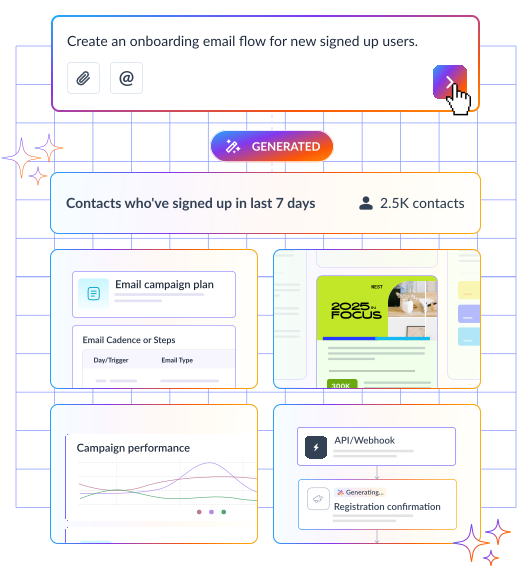
We asked Mailmodo AI to create a back-in-stock campaign plan with clear objectives, email count, timing, and CTAs. It gave us a structured plan that could be quickly adapted for different products and categories.
Take a look at the prompt we used. Click on the arrow to see the output we received.
Create a back-in-stock email campaign plan for an ecommerce brand. Include campaign objectives, number of emails, timing between emails, key messaging for each email, and the primary CTA.
Step 2: Create audience segments
Segmentation ensures that only relevant customers receive the back-in-stock emails. This improves engagement and avoids sending unnecessary messages to uninterested users. For ecommerce back-in-stock flows, segmentation is usually based on product-level behavior and purchase status.
Common attributes to segment users include:
- Product viewed or subscribed to
- Stock status of the product
- Purchase status
- Time since last engagement
- Customer vs. first-time visitor
You can use Mailmodo AI to create a segment of users who viewed a specific product while it was out of stock and have not purchased it yet.
Take a look at the prompt we used, along with the output we got.
Create a dynamic segment of users who viewed a specific product when it was out of stock and have not completed a purchase yet. Exclude users who already bought the product.
Step 3: Create the email templates
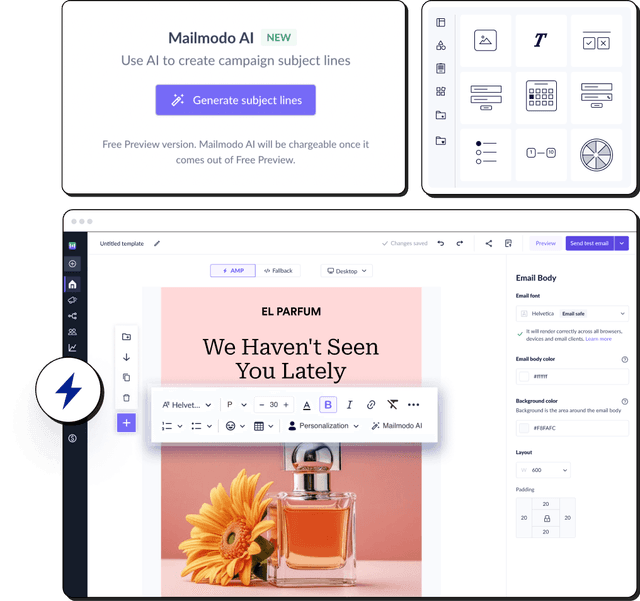
Once your audience is ready, the next step is designing the actual emails. Here’s a sample list of emails that you should be creating for your welcome email sequence. We’ve also included sample prompts that you can use in Mailmodo AI to generate these email templates in minutes instead of having to spend hours creating them.
Email #1: Back in stock notification
When to send: Immediately when the product is restocked.
Purpose: Inform customers that the product they wanted is available again and prompt immediate action.
What to include:
- Clear “Back in stock” message
- Product name and image
- Price and key product details
- Primary CTA to view or buy the product
Here’s a sample prompt to generate this kind of email, along with the output it will produce.
Generate a back-in-stock email for an ecommerce product. Include a clear restock announcement, product details, and a primary CTA to purchase the product.
Email #2: Limited availability reminder
When to send: 1–2 days after Email #1, if the user hasn’t purchased.
Purpose: Create urgency and nudge users who may have delayed their decision.
What to include:
- Reminder that the product is available
- Limited stock or high-demand messaging
- Social proof or popularity cues
- CTA to complete the purchase
Here’s a sample prompt to generate this kind of email, along with the output it will produce.
Generate a follow-up back-in-stock email that highlights limited availability and encourages users to purchase before the product runs out again.
Step 4: Build the automated workflow
Automation ties everything together and ensures the sequence runs without manual effort. A typical back-in-stock workflow looks like this:
- Trigger: Product status changes from out of stock to in stock
- Delays: 0 days → 1–2 days
- Branching logic: If purchased → exit flow; if not purchased → continue sequence
- Exit criteria: User completes purchase or product goes out of stock again
We used Mailmodo AI to generate this entire workflow automatically. It mapped triggers, delays, conditions, and exit rules in one go. After reviewing the journey, we made small tweaks to timing and urgency messaging before activating the flow.
Take a look at the prompt that we used and the output we received.
Generate a complete automated workflow for a back-in-stock email sequence. Include triggers, delays, branching logic, and exit conditions based on purchase behavior.
Step 5: Analyze and improve
Even short sequences benefit from ongoing optimization. Tracking the right metrics helps you understand whether customers are noticing, clicking, and converting. For your back-in-stock sequence, key metrics to monitor include:
- Open rate
- Click-through rate
- Conversion rate
- Time to purchase after restock
- Revenue generated per restock campaign
You can also ask Mailmodo AI to analyze your back-in-stock campaigns and suggest improvements. It would highlight subject line performance, timing gaps, and opportunities to add urgency cues in follow-up emails.
Here’s a sample prompt that you can use for this:
Analyze my back-in-stock email sequence and recommend improvements to increase opens, clicks, and purchases.
Conclusion
For ecommerce brands, back-in-stock moments are high-intent opportunities that shouldn’t be left to chance. Customers have already shown interest. You just need to reach them at the right time with the right message and a back-in-stock email sequence is just the right tool you need.
With tools like Mailmodo, planning, creating, automating, and optimizing these sequences becomes far simpler and faster. Once set up, your back-in-stock flow can quietly turn inventory updates into consistent revenue.


 Learn more about Mailmodo