

In ecommerce, growth doesn’t always come from acquiring new customers. In fact, constantly spending on ads to bring in new buyers gets expensive fast. The real opportunity lies with customers who already trust your brand and have purchased from you before.
At this stage, customers are familiar with your products, your pricing, and your experience. That makes upselling and cross-selling one of the most effective ways to increase average order value and lifetime value without increasing acquisition costs.
The challenge is that most customers don’t automatically explore upgrades, add-ons, or complementary products on their own. They need timely reminders, relevant recommendations, and a bit of persuasion. This is where a well-planned upsell/cross-sell email sequence works better than one-off promotional emails.
In this guide, we’ll walk through how to build a complete upsell/cross-sell email sequence for an ecommerce brand.
Why should you use an email flow?
Email is especially effective for upsell and cross-sell in ecommerce because you’re speaking directly to people who already know your brand and products.
Unlike ads or social posts, email allows you to personalize recommendations based on what a customer has already purchased. You can suggest premium versions, complementary products, or bundles that actually make sense for them. With segmentation and automation, these messages can land at the right moment.
Upselling and cross-selling also rarely happen in a single interaction. Customers may need to see the product, understand its value, compare options, and feel confident before buying. Multiple touchpoints help you address budget concerns, build trust through social proof, and gently nudge them toward a decision.
That’s why a structured email sequence works far better than sending just one promotional email.
What is an upsell/cross-sell email sequence?
An upsell/cross-sell email sequence is a series of automated emails sent to existing customers to encourage them to buy a premium version of a product, add complementary items, or purchase related products.
These emails usually include product recommendations, limited-time discounts, customer reviews, reminders, and final nudges. Together, they guide customers from awareness to purchase without feeling pushy or repetitive.
How to build an upsell/cross-sell email sequence
Building an email sequence can be easy if you’re following a well-defined set of steps. Here are the steps for you to follow:
Step 1: Plan your campaign
Before creating emails, you need a clear plan. This ensures the sequence feels intentional and relevant rather than random promotions. Start by outlining the core elements of your upsell/cross-sell campaign:
- Objective: Increase average order value, promote premium products, or sell add-ons
- Target audience: Recent buyers, repeat customers, or category-specific purchasers
- Core message: How the recommended product improves or enhances what they already bought
- Number of emails: Typically 4 emails
- Timeline: Spread across 10–14 days
For ecommerce, planning also means mapping products logically. Upsells should clearly offer more value, while cross-sells should naturally complement the original purchase.
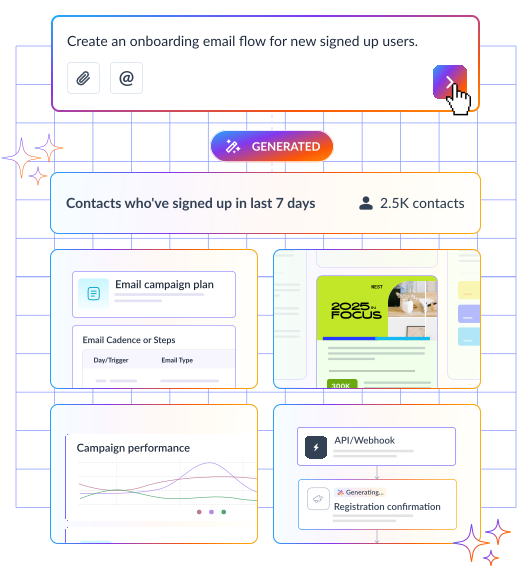
We used Mailmodo AI to create a complete campaign plan along with objectives, email themes, timing, and CTAs for an upsell/cross-sell sequence. The output gave us a clear structure that we could quickly review and customize.
Take a look at the prompt we used. Click on the arrow to see the output we got.
Create an upsell and cross-sell campaign plan for an ecommerce brand. Include objectives, number of emails, theme of each email, timing between emails, and the main CTA for each email.
Step 2: Create audience segments
Segmentation is what makes upsell and cross-sell emails feel relevant instead of spammy. Not every customer should receive the same product recommendations. You can segment customers based on:
- Products purchased
- Product category
- Order value
- Purchase frequency
- Time since last purchase
- Engagement with previous emails
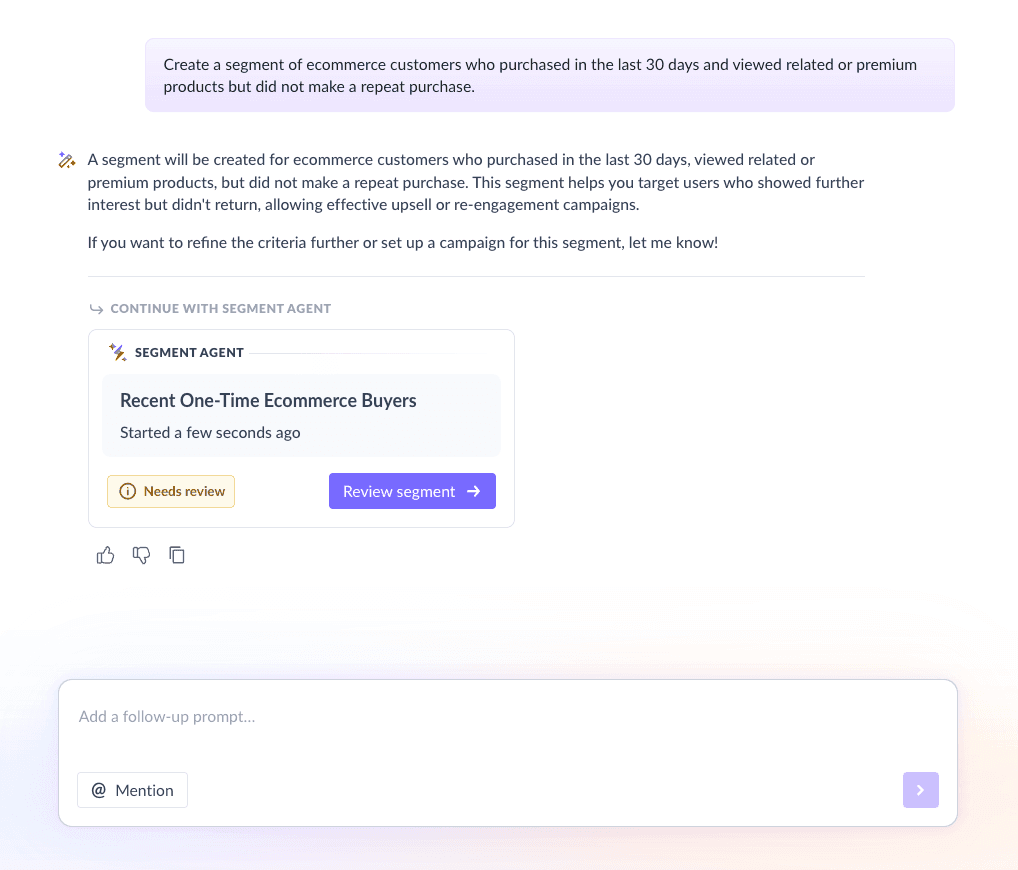
For this sequence, we created a segment of customers who made a purchase in the last 30 days and viewed or clicked on related products but didn’t buy again. This ensures we’re targeting people who are most likely to be interested.
Create a segment of ecommerce customers who purchased in the last 30 days and viewed related or premium products but did not make a repeat purchase.
Step 3: Create the email templates
Once the audience is ready, it’s time to create the emails. Here’s a sample list of emails that you should be creating for your email flow. We’ve also included sample prompts that you can use in Mailmodo AI to generate these email templates in minutes instead of having to spend hours creating them.
Email #1: Offer email
When to send: 2–3 days after purchase Purpose: Introduce relevant upsell or cross-sell products What to include:
- Product recommendations related to their purchase
- Clear benefits and use cases
- Visuals that show how the products work together
Here’s a sample prompt to generate this kind of email, along with the output it will produce.
Generate an upsell/cross-sell email recommending complementary products to customers who recently purchased from an ecommerce store.
Email #2: Discount email
When to send: 3–4 days after Email #1 Purpose: Overcome friction because of price What to include:
- Limited-time discount or exclusive coupon
- Clear expiration to create urgency
- Reminder of the product’s value
Here’s a sample prompt to generate this kind of email, along with the output it will produce.
Generate a discount email offering a limited-time coupon for premium or complementary ecommerce products.
Email #3: Social proof
When to send: 3–4 days after Email #2 Purpose: Build trust and reduce uncertainty What to include:
- Customer reviews or testimonials
- Ratings or user-generated content
- Short stories showing real outcomes
Here’s a sample prompt to generate this kind of email, along with the output it will produce.
Generate an ecommerce email showcasing reviews and testimonials for upsell or cross-sell products to build trust.
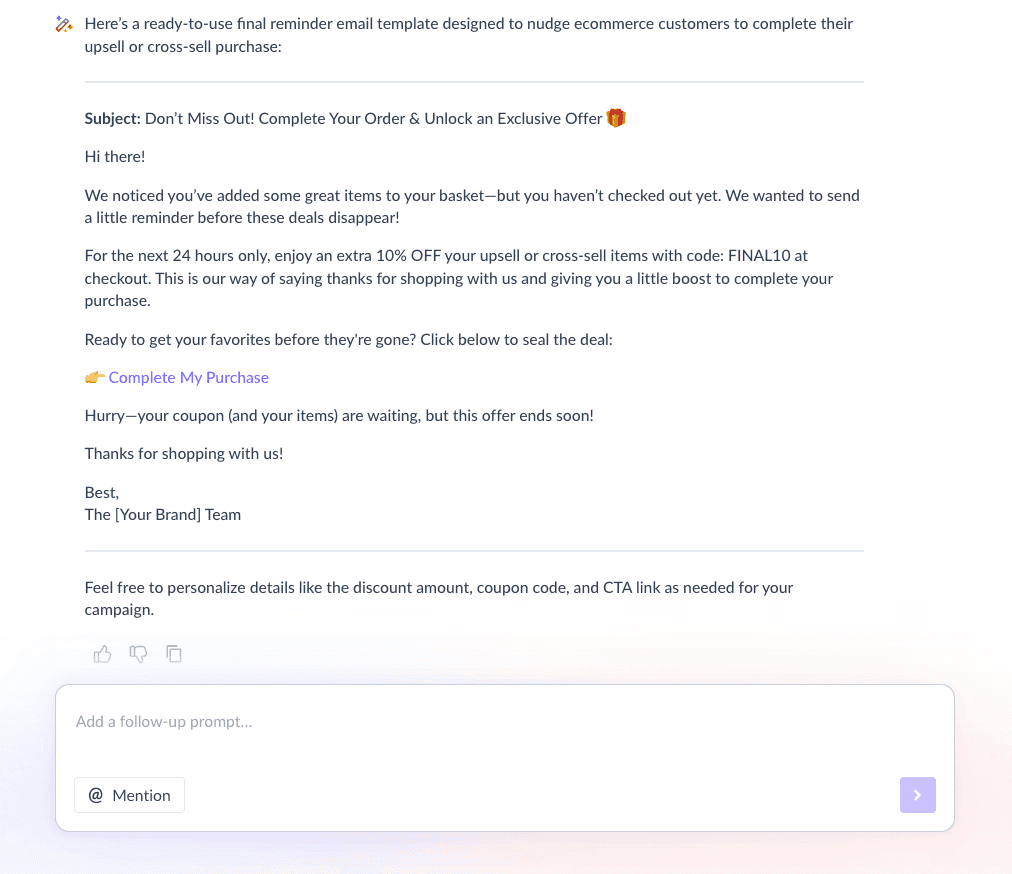
Email #4: Nudge email
When to send: 2–3 days after Email #3 Purpose: Nudge to take action What to include:
- Reminder of the offer or product
- Reinforced benefits
- Clear CTA
Here’s a sample prompt to generate this kind of email, along with the output it will produce.
Generate a final reminder email nudging customers to complete their upsell or cross-sell purchase for an ecommerce store.
Step 4: Build the automated workflow
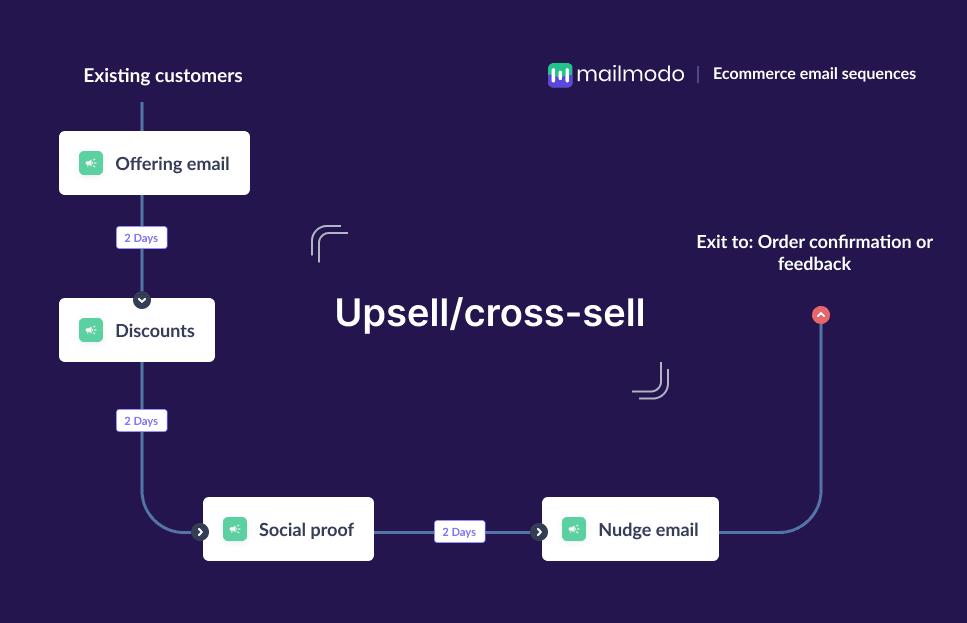
Once your emails are ready, the next step is to automate them so every new user receives them at the right moment. For this upsell/cross-sell flow, the setup looks like this:
- Trigger: Customer completes a purchase
- Delays: 2 days → 3 days → 3 days → 2 days
- Branching logic: If customer makes a purchase → exit flow; If not → continue sequence
- Exit criteria: Purchase completed or moved to feedback flow
You can use Mailmodo AI to generate a complete automated workflow, including triggers, delays, and exit rules. Once the workflow is ready, you can review it and adjust timing based on your store’s buying cycle.
Take a look at this sample prompt that you can use.
Generate a complete automated upsell and cross-sell workflow for an ecommerce brand. Include triggers, delays, branching logic, and exit criteria.
Step 5: Analyze and improve
No email sequence should stay static. Tracking performance helps you understand what’s working and where customers drop off. Key metrics to track for upsell/cross-sell include:
- Open rate
- Click-through rate
- Conversion rate
- Revenue per email
- Unsubscribe rate
You can ask Mailmodo AI to analyze the sequence performance and suggest improvements. It will highlight which emails need better product framing and where timing could be optimized.
Here’s a sample prompt that you can use for this:
Analyze my upsell and cross-sell email sequence performance and recommend improvements to increase conversions and revenue.
Conclusion
For ecommerce brands, upsell and cross-sell sequences are one of the most reliable ways to grow revenue without increasing acquisition costs. They help you get more value from existing customers by offering products that genuinely enhance their purchase.
With a tool like Mailmodo, planning, creating, automating, and optimizing upsell/cross-sell email sequences becomes far more efficient. Once set up, these flows continue driving revenue while you focus on growing your brand.


 Learn more about Mailmodo