



In ecommerce, your work doesn’t end just because the customer has made a purchase. In fact, that’s where long-term value really begins. Their reviews influence the buying decisions of others, improve product visibility on marketplaces, and build trust for future shoppers.
A structured post-purchase review email sequence works well for ecommerce stores. It helps you thank customers, nudge them at the right time, and encourage repeat purchases without being intrusive.
In this guide, we’ll walk through how to build a complete post-purchase review email sequence for your ecommerce store.
Why should you use an email flow?
Email is one of the most effective channels for collecting post-purchase reviews in ecommerce because it reaches customers directly after they’ve experienced the product. Unlike ads or social media, email allows you to control timing, personalize messages, and follow up automatically.
With email, you can:
- Reach customers when they’re most likely to review (after delivery)
- Personalize messages using order and product details
- Segment users based on actions like purchases or reviews
- Automate reminders without much manual effort
One email is rarely enough. Customers may miss the first message, forget to respond, or need an incentive to act. A sequence with multiple touchpoints increases visibility, reinforces intent, and improves overall review conversion. That’s why a post-purchase email sequence is ideal.
What is a post-purchase email sequence?
A post-purchase email sequence is a series of automated emails sent to customers after they receive their order, with the goal of collecting product feedback and encouraging repeat purchases.
These emails typically include thank-you messages, review requests, reminders, incentives, and follow-up offers. Together, they guide customers from purchase completion to feedback submission and future engagement.
How to build a post-purchase review email sequence
Building an email sequence can be easy if you’re following a well-defined set of steps. Here are the steps for you to follow:
Step 1: Plan your campaign
Planning sets the foundation for the entire email sequence. Without clarity on goals and timing, price drop emails can feel random or overly promotional. You can start by outlining:
Primary objective: Collect product reviews
Secondary objectives: Build loyalty and drive repeat purchases
Target audience: Customers who have received their order
Number of emails: 2–3 emails
Timeline: 5–7 days after delivery
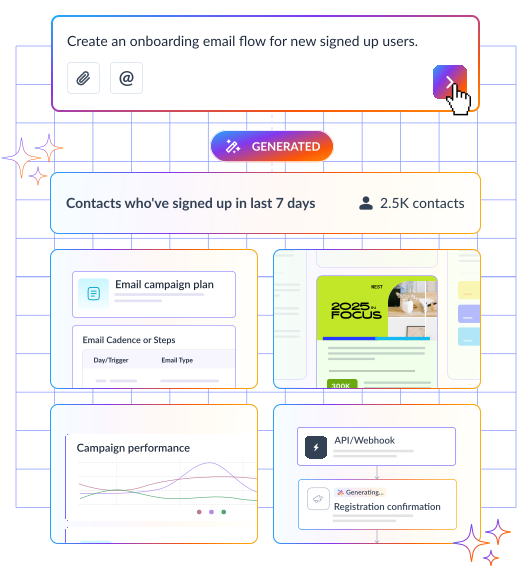
We used Mailmodo AI to generate a complete campaign plan for an ecommerce post-purchase email sequence. It defined the objectives, email count, timing, and CTAs in one go.
Take a look at the prompt we used. Click on the arrow to see the output we received.
Create a post-purchase review email campaign plan for an ecommerce store. Include objectives, number of emails, timing after delivery, and the main CTA for each email.
Step 2: Define the trigger
Defining the trigger ensures your review emails are relevant and timely. Not every customer should receive the same message at the same time. For a post-purchase review sequence, you can use a successful purchase as the trigger.
Step 3: Create the email templates
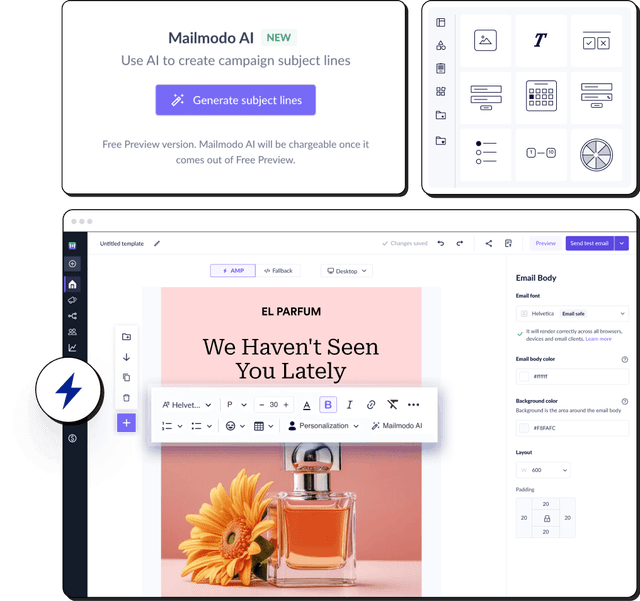
Once your audience is ready, the next step is creating the individual emails that will make up the sequence. Here’s a sample list of emails that you should be creating for your price drop email sequence. We’ve also included sample prompts that you can use in Mailmodo AI to generate these email templates in minutes instead of having to spend hours creating them.
Email #1: Thank customers for their purchase
When to send: 2–3 days after delivery
Purpose: Express gratitude and ask for feedback
What to include:
- Thank-you message
- Product name and image
- Simple review request
- Direct link or embedded review form
Here’s a sample prompt to generate this kind of email, along with the output it will produce.
Generate a thank-you email for an ecommerce post-purchase review sequence. Include a short appreciation message, product reference, and a simple review request.
Email #2: Incentivize feedback
When to send: 2–3 days after Email #1 (if no review)
Purpose: Encourage review submission with an incentive
What to include:
- Friendly reminder
- Discount or reward for leaving a review
- Clear review CTA
- Expiry or urgency cue
Here’s a sample prompt to generate this kind of email, along with the output it will produce.
Generate a follow-up email that incentivizes customers to leave a product review. Include a discount reward and a clear CTA.
Email #3: Offer on next purchase
When to send: 2–3 days after Email #2
Purpose: Build loyalty and encourage repeat purchase
What to include:
- Exclusive next-purchase offer
- Product recommendations
- Reminder that their feedback is valued
- Coupon or store credit details
Here’s a sample prompt to generate this kind of email, along with the output it will produce.
Generate a post-purchase email offering an exclusive discount on the next purchase. Focus on loyalty and repeat buying.
Step 4: Build the automated workflow
Automation ties everything together and ensures customers move through the sequence smoothly. Here’s a sample post-purchase email sequence structure:
- Trigger: Order marked as delivered
- Delays: 2–3 days → 2–3 days → 2–3 days
- Branching logic: If review submitted → exit flow; If new purchase made → move to order confirmation flow
- Exit criteria: Review submitted or new purchase completed
We used Mailmodo AI to generate the full automated workflow from scratch. It mapped triggers, delays, conditions, and exits. Once the output was ready, we just had to review the overall journey following a setup checklist and ask the AI to make the tweaks we wanted in the workflow.
Take a look at the prompt that we used and the output we received.
Generate an automated ecommerce post-purchase review email workflow. Include triggers, delays, branching logic, and exit conditions.
Step 5: Analyze and improve
Tracking the performance of your post-purchase email sequence helps you refine the sequence and increase review conversions over time. Focus on metrics that reflect both engagement and outcomes. Key metrics for you to track includes:
- Open rate
- Click-through rate
- Review submission rate
- Incentive redemption rate
- Repeat purchase rate
You can also ask Mailmodo AI to analyze the performance of your email sequence and suggest optimizations based on engagement and conversion data. Here’s a sample prompt that you can use for this:
Analyze my ecommerce post-purchase review email sequence. Recommend improvements to increase review submissions and repeat purchases.
Conclusion
For ecommerce brands, post-purchase reviews are essential for trust, visibility, and growth. A well-timed post-purchase email sequence helps you thank customers, capture feedback, and encourage loyalty through thoughtful follow-ups.
When email is combined with automation and smart segmentation, it becomes a scalable way to build long-term customer relationships. Mailmodo makes it easier to plan, create, automate, and optimize post-purchase review email sequences without adding complexity. With the right flow in place, you can turn every order into an opportunity for feedback and repeat business.


 Learn more about Mailmodo