


In eCommerce, getting people to sign up is only half the battle. The real challenge is getting them to come back, explore your products, and actually make a purchase.
Most new subscribers don’t buy right away. They’re still browsing, comparing options, or trying to understand what makes your store worth choosing over others. If you don’t guide them at this stage, they either forget about your brand or move on to a competitor.
That’s where a product recommendation email sequence becomes critical. Instead of leaving discovery to chance, you proactively show shoppers what you sell, what’s popular, and why others love your products. In this guide, we’ll walk through how to build a complete product recommendation email sequence for an eCommerce business.
Why should you use an email flow?
Email is one of the most effective channels for product recommendations in eCommerce because it gives you direct access to shoppers who’ve already shown interest in your brand.
Unlike ads or social posts, emails land in a personal inbox. You can personalize recommendations based on browsing behavior, signup source, or past interactions. You can also control timing so you’re sending messages when users are most likely to browse or buy.
Product discovery rarely happens in one touchpoint. A single email showing products may spark interest, but it often takes multiple nudges in the form of recommendations, reviews, and offers, to push someone toward checkout. A sequence allows you to build familiarity and confidence over time instead of forcing a rushed decision.
What is a product recommendation email sequence?
A product recommendation email sequence is a series of automated emails sent to subscribers to introduce relevant products, reinforce interest with social proof, and encourage purchases through incentives or offers.
These emails usually include product highlights, customer reviews or UGC, reminders, and limited-time offers. Together, they guide subscribers from discovery to purchase in a logical, low-pressure way.
How to build a product recommendation email sequence
Building an email sequence can be easy if you’re following a well-defined set of steps. Here are the steps for you to follow:
Step 1: Plan your campaign
Planning sets the foundation for the entire sequence. Without clarity on goals and structure, product recommendation emails can feel random or overly promotional. Start by outlining the key elements of your campaign:
Objective: Drive first purchase or repeat purchase
Audience: New subscribers who haven’t purchased yet
Messaging theme: Discovery, trust-building, and value
Number of emails: 2–3 emails
Timeline: Spread over 5–7 days
Primary CTA: Visit product pages or make a purchase
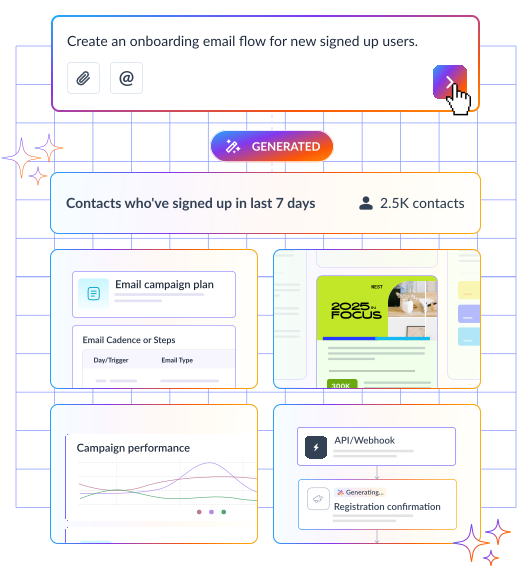
To speed this up, we used Mailmodo AI to generate a complete campaign plan. We asked it to outline objectives, number of emails, timing, and goals for each email. The output gave us a clear roadmap that we could refine and directly convert into an automated sequence. Take a look at the prompt we used. Click on the arrow to see the output we received.
Create a product recommendation email campaign plan for an eCommerce brand. Include objectives, number of emails, timing between emails, the goal of each email, and the primary CTA.
Step 2: Create audience segments
Segmentation ensures that your product recommendations actually feel relevant. Sending the same products to every subscriber reduces engagement and conversions. For an eCommerce product recommendation flow, segmentation can be based on:
Signup source (homepage, blog, discount popup)
Browsing behavior
Product category viewed
Engagement level
Purchase status
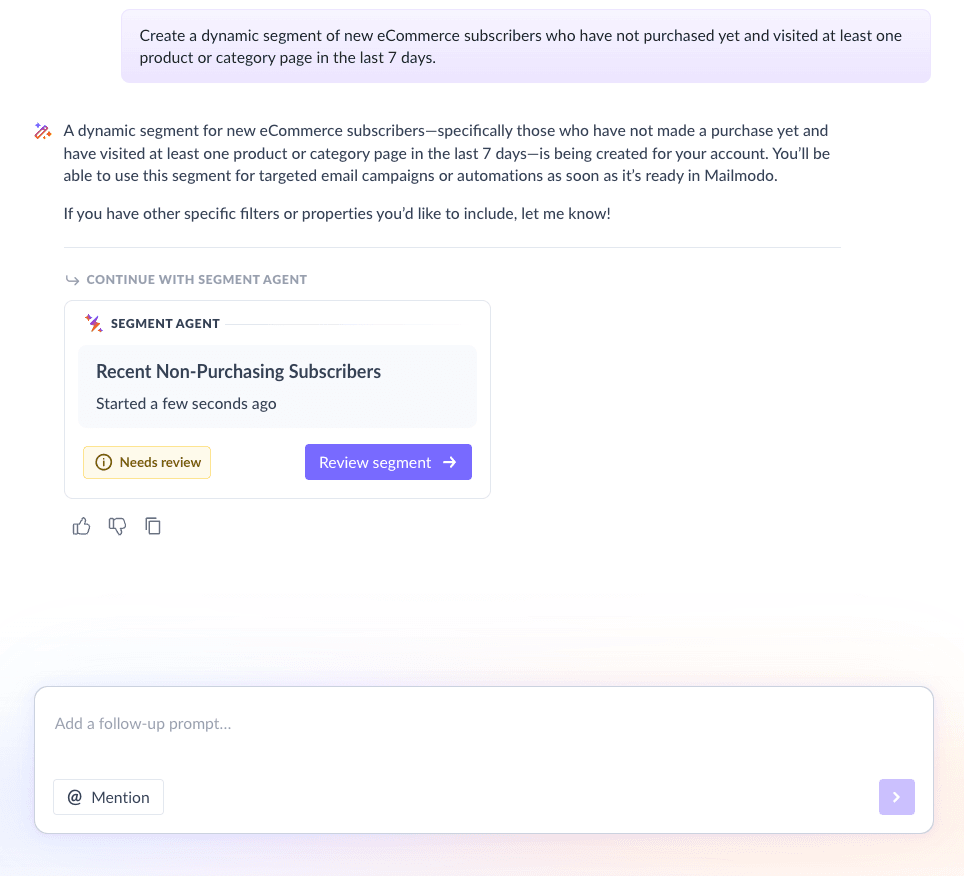
We used Mailmodo AI to quickly create an audience segment for us. In this sequence, we created a segment of:
New subscribers
No purchases yet
Visited at least one product or category page in the last 7 days
Once it was done, we got the option to review, make edits using the builder, or ask AI to carry out the changes we wanted. Once we confirmed, Mailmodo AI created the segment instantly and it was ready to use for our campaign.
Create a dynamic segment of new eCommerce subscribers who have not purchased yet and visited at least one product or category page in the last 7 days.
Step 3: Create the email templates
Once your audience is defined, it’s time to create the actual emails. This sequence includes three emails, each serving a distinct purpose. We’ve also included sample prompts that you can use in Mailmodo AI to generate these email templates in minutes instead of having to spend hours creating them.
Email #1: Product recommendation
When to send: Immediately or within 1 day of signup
Purpose: Introduce products and drive the first site revisit
What to include:
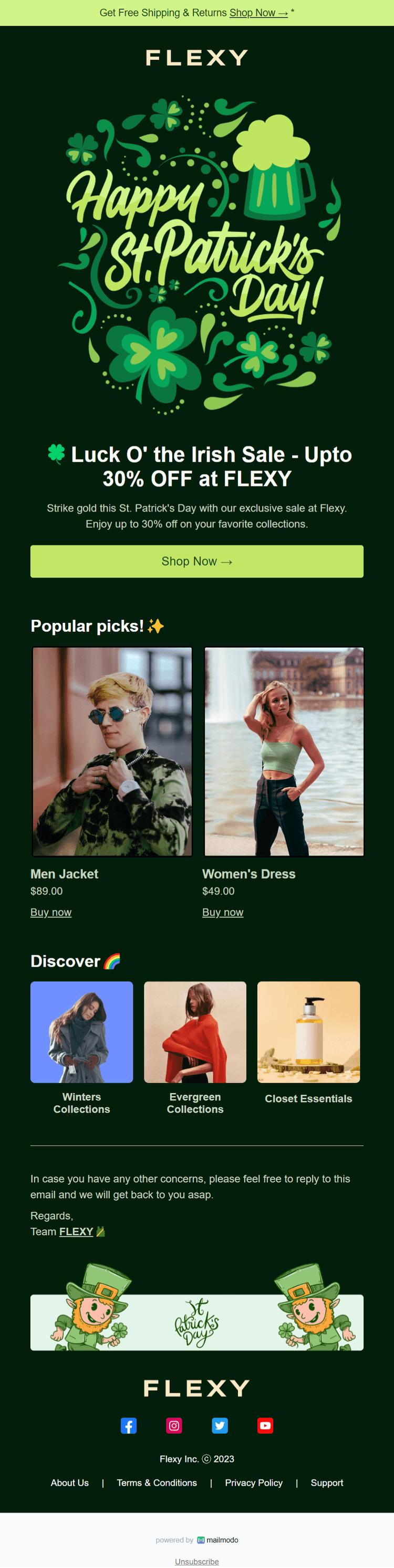
Bestselling or trending products
Products viewed or related categories
Short product descriptions
Clear CTA to explore products
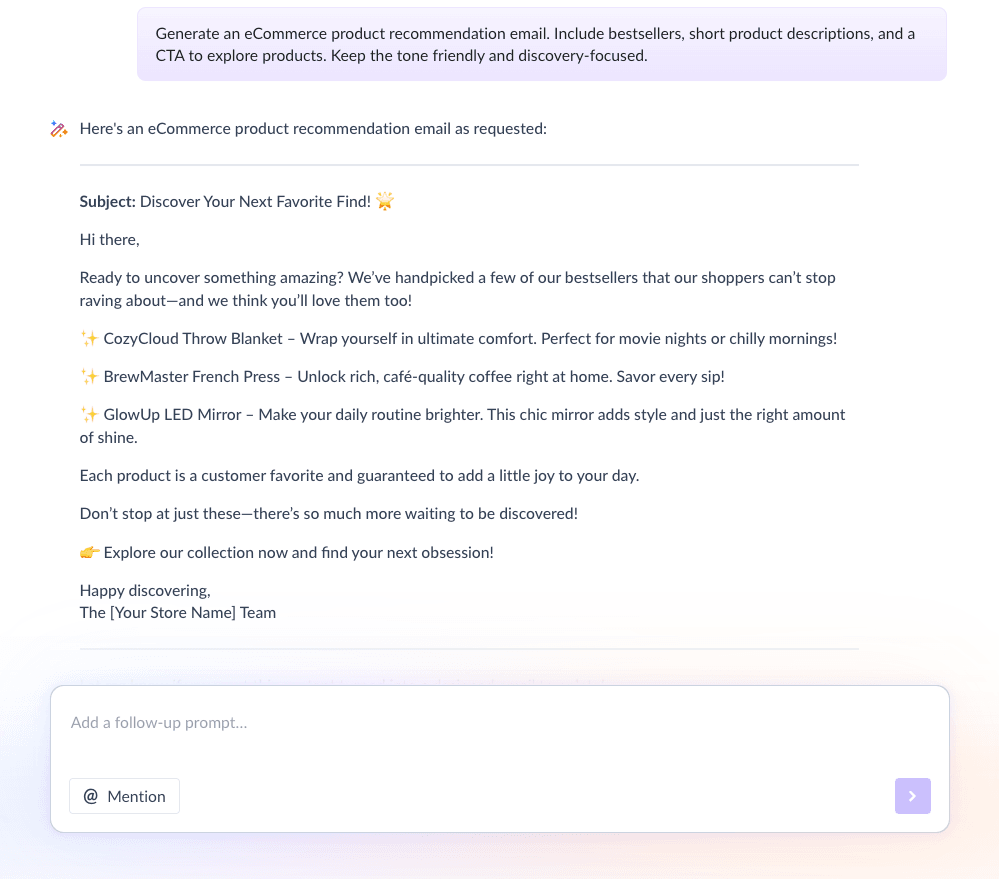
Here’s a sample prompt to generate this kind of email, along with the output it will produce.
Generate an eCommerce product recommendation email. Include bestsellers, short product descriptions, and a CTA to explore products. Keep the tone friendly and discovery-focused.
Email #2: Social proof
When to send: 2–3 days after Email #1
Purpose: Build trust and reduce hesitation
What to include:
Customer reviews for recommended products
User-generated content from social media
Testimonials highlighting real use cases
CTA to view products again
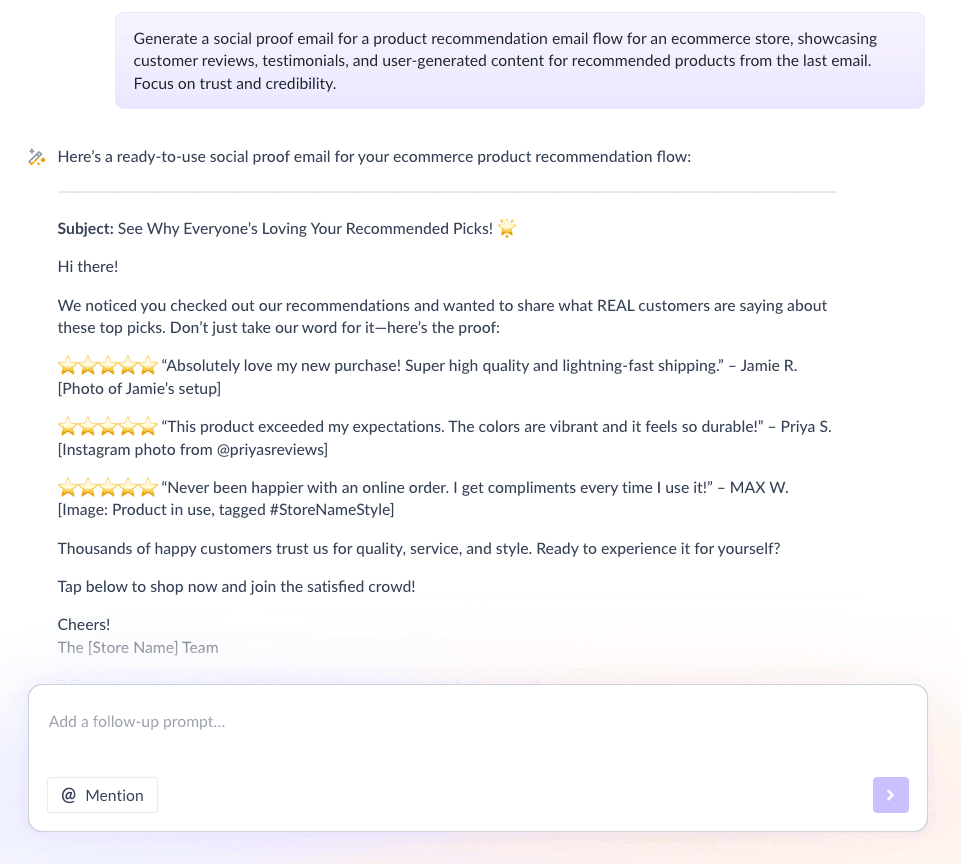
Here’s a sample prompt to generate this kind of email, along with the output it will produce.
Generate a social proof email for a product recommendation email flow for an ecommerce store, showcasing customer reviews, testimonials, and user-generated content for recommended products from the last email. Focus on trust and credibility.
Email #3: Offer email
When to send: 2–3 days after Email #2
Purpose: Push undecided subscribers to purchase
What to include:
Limited-time discount or offer
Products previously recommended
Urgency-driven copy
Strong purchase CTA
Here’s a sample prompt to generate this kind of email, along with the output it will produce.
Generate a social proof email for a product recommendation email flow for an ecommerce store, showcasing customer reviews, testimonials, and user-generated content for recommended products from the last email. Focus on trust and credibility.
Step 4: Build the automated workflow
Once your emails are ready, the next step is to automate them so every new user receives them at the right moment. Your email flow should include:
Trigger: User subscribes
Delays: Email 1: Immediately; Email 2: After 2–3 days; Email 3: After 2–3 days
Branching logic: If purchase made → exit flow and move to post-purchase
Exit criteria: User completes a purchase or reaches end of sequence
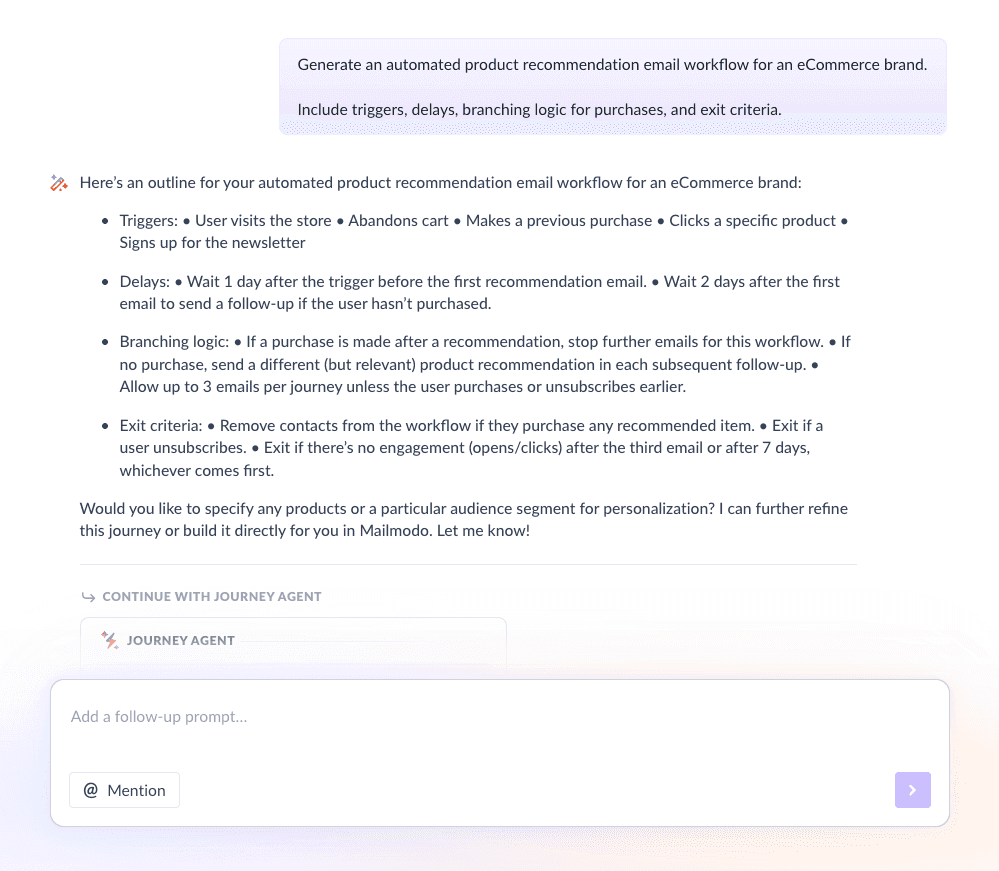
We used Mailmodo AI to generate the entire workflow, including triggers, delays, and exit rules. Once the output was ready, we just had to review the overall journey following a setup checklist and ask the AI to make the tweaks we wanted in the workflow.
Take a look at the prompt that we used and the output we received.
Generate an automated product recommendation email workflow for an eCommerce brand. Include triggers, delays, branching logic for purchases, and exit criteria.
Step 5: Analyze and improve
Even well-built sequences need optimization. Tracking the right metrics helps you understand what’s working and what needs improvement. Key metrics to monitor include:
Open rate
Click-through rate
Product page visits
Conversion rate
Revenue per email
We asked Mailmodo AI to analyze past campaign performance and suggest improvements. Take a look at the prompt that we used and the output we received.
Analyze my lasy product recommendation email sequence performance. Identify drop-off points and suggest improvements to increase clicks and purchases.
Conclusion
A well-structured product recommendation email sequence helps bridge that gap by guiding subscribers from interest to purchase. By combining email sequencing with personalization, social proof, and timely offers, you can turn new subscribers into paying customers without overwhelming them.
Tools like Mailmodo make it easier to plan, create, automate, and optimize these sequences. Once this foundation is in place, you can continue refining and expanding your flows to drive consistent revenue growth.


 Learn more about Mailmodo