What is an email marketing strategy?
An email marketing strategy is a comprehensive plan or approach that businesses use to leverage the power of email communication for marketing purposes.
It involves creating and implementing a series of tactics and techniques to effectively reach and engage a target audience.
Benefits of creating an email marketing strategy
Creating an effective email marketing strategy offers the best results for businesses and organizations. Here are some key advantages:
1. Targeted communication
An email marketing strategy allows you to segment your audience and send tailored messages based on their interests, behavior, or demographics. This leads to more relevant and effective communication.
2. Cost optimization
Compared to traditional marketing channels, email marketing is relatively inexpensive. With a solid strategy, you can achieve high returns on investment (ROI) with minimal costs.
3. Increased engagement
By delivering personalized and valuable content, you can increase engagement rates. Emails can be designed to encourage readers to take specific actions, such as clicking through to your website or making a purchase.
4. Measurable results
Email marketing provides detailed analytics and metrics. You can track open rates, click-through rates, conversion rates, and more, allowing you to measure the success of your campaigns and adjust strategies at the right time.
You, as an email marketer, can leverage these benefits to organize successful email marketing campaigns and drive growth.
How to create an effective email marketing strategy?
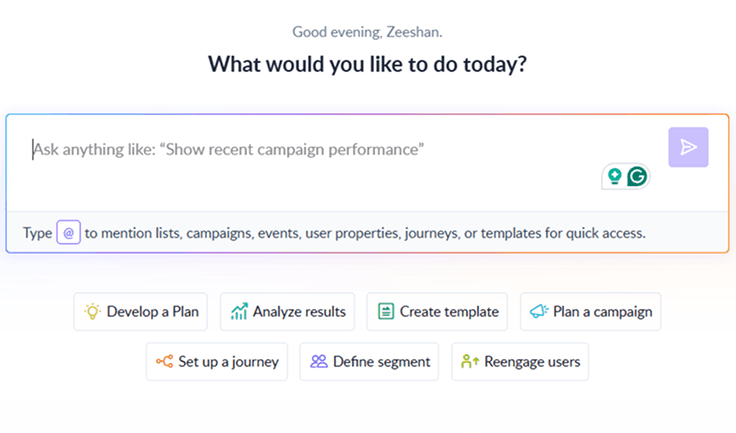
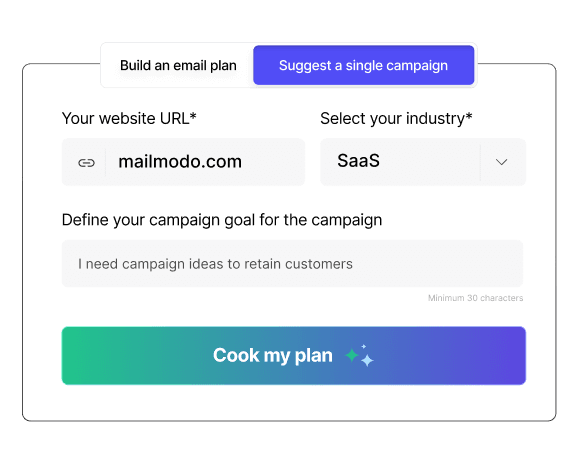
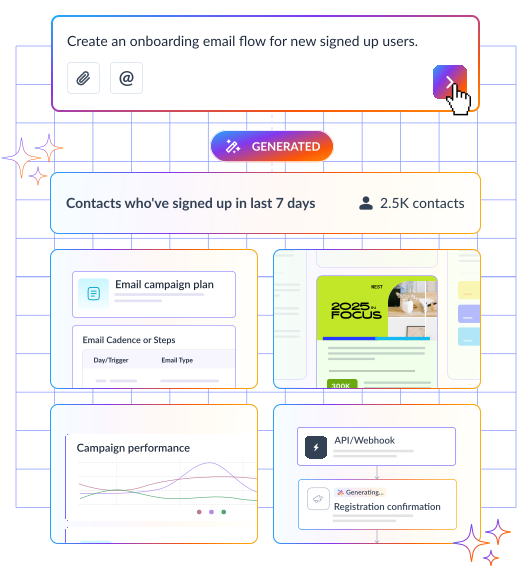
As a business, you have two ways to develop a strategy these days. You can use AI Campaign Planner like Mailmodo to automatically suggest campaign goals, audience segments, and email sequences. This saves time while still allowing you full control to refine the strategy according to your unique business needs.

Your AI Assistant for Everything Email Marketing
Alternatively, you plan each step manually. When creating a strategy from scratch, focus on:
- Defining the goals and objectives of your campaigns
- Targeting audiences for your email marketing campaigns
- Implementing a SWOT analysis of past email campaigns
- Identifying the types of emails and the email cadence
- Using automation for more effective behavioral targeting and customer segmentation
What does a good email marketing strategy look like?

A good email marketing strategy covers most of the steps shared above and all of these steps that are relevant to their business model. As every business owner has a different set of offerings, services, and target audiences, his email marketing needs are also different. Hence, every business has different goals, targets, and deliverables in its strategy.
However, there are some key elements of every right email marketing strategy, as shown in the image above.
A good email marketing strategy:
Helps you diversify your messaging for a 360-degree reach with better brand awareness.
Offers list monetization.
Increases email ROI.
Makes your campaigns agile, dynamic, and appealing to the audience.
Allows you to leverage email marketing automation.
Keeps email optimization and sending frequency in mind.
15 Brilliant Email Marketing Strategies For Winning Campaign
Here are the 15 key email marketing strategies with expert advice from fellow marketers to create an email campaign that gets you revenue whether you are using it for enterprise, small business, or online stores.

1. Understand your ideal customer profile
One effective approach is to engage with your existing customers through various means such as email communication, conducting Zoom interviews, or distributing surveys. By doing so, you can gain a deeper understanding of the motivations of your ICP(Ideal Customer Profile) behind purchasing your product and customer loyalty.
With Mailmodo, you can create and send interactive market research surveys inside emails to collect valuable information about them. Read how you can get ~2X more revenue using market research forms inside AMP emails.
What stood out for us with Mailmodo is that we could drive the communication to the candidate. They didn’t have to leave the comfort of their email to fill out a survey or schedule an interview.
- Aashish Mittal, Co-Founder and CTO, Interviewvector
2. Know your campaign goals
This stage can be divided into two steps:
1. What and Why: Aims and Objectives
During this stage, you thoroughly explore your campaign’s ultimate goal because targeted emails convert better, build credibility, and boost your sales.
Some of the common email marketing best practices or objectives include:
Sharing information about a newly launched product.
Getting your customers to sign up for your services.
Getting your customers to buy your product or renew their subscriptions.
Informing your customers about a new feature or service.
2. How: How to implement STP (Segment, Target, and Position)?
The next part is to identify and establish the ground rules for measuring the progress and success of your email marketing campaign. To ensure that your CTAs get clicks and good responses, you must:
Segment your customers and target audiences based on various parameters, such as behavior, preferences, purchase capacities, and previous data, for better results.
Target your campaigns for each customer segment and offer them personalized offers, information, and deliverables.
Position your campaigns to stay aligned with your email marketing goals.
Set specific metrics to measure the progress and success of your email campaigns.
3. Optimize your email campaigns by segmentation
Sending the email campaign to your entire list will hurt your email strategy and marketing efforts. Not everyone will like your email and might unsubscribe or mark it as spam.
That is why email segmentation helps. According to eMarketer, 39% of email marketers who practice list segmentation see better open rates, and 24% see increased sales leads.
To get started, segment your email list by:
4. Personalize your emails
Email personalization goes far beyond just using a subscriber’s first name; it’s about delivering the right message to the right person at the right time
When emails are customised according to individual preferences, they drive stronger engagement and foster long-term relationships. In fact, research from SmarterHQ found that 72% of consumers say they only engage with marketing messages that are customized to their specific interests
Effective personalization includes:
Using dynamic content to display text or images based on user data
Segmenting strategically by grouping subscribers with similar traits or interests
Triggering emails based on behavior like browsing, purchases, or cart abandonment
Tools like Mailmodo let you easily create and automate dynamic emails with custom subject lines, product recommendations, and interactive content.
5. Always deliver value
As every marketer says "content is king". And investing in content marketing is worth every penny. Creating valuable and relevant content is hard but possible.
After segmenting your contact list based on their preferences, you might now know their wants, needs, and characteristics. Just make sure to share content that resonates with the right people and solves their problems.
Never shy away from asking for feedback from your new subscribers or loyal customers. It is always a good idea to send out an email survey to find out what works and what does not.
Provide value with every email. We include sample marketing insights from our email newsletter even in our subscription confirmation message. It'll increase brand affinity, open rates, conversion rates, and decrease unsubscribe rates.
- Neal O'Grady, Co-Founder, Demand Curve
6. Nail your subject lines
Email subject lines help improve your email open rate. A 2024 report by Campaign Monitor found that emails with personalized subject lines see a 26% increase in open rates. Furthermore, emails with subject lines of 6–10 words tend to perform best across industries.
Here are some best email marketing tips to improve your subject lines:
💡 Pro-tip: Mailmodo lets you A/B test your email subject lines to find what works and improve it on further campaigns.
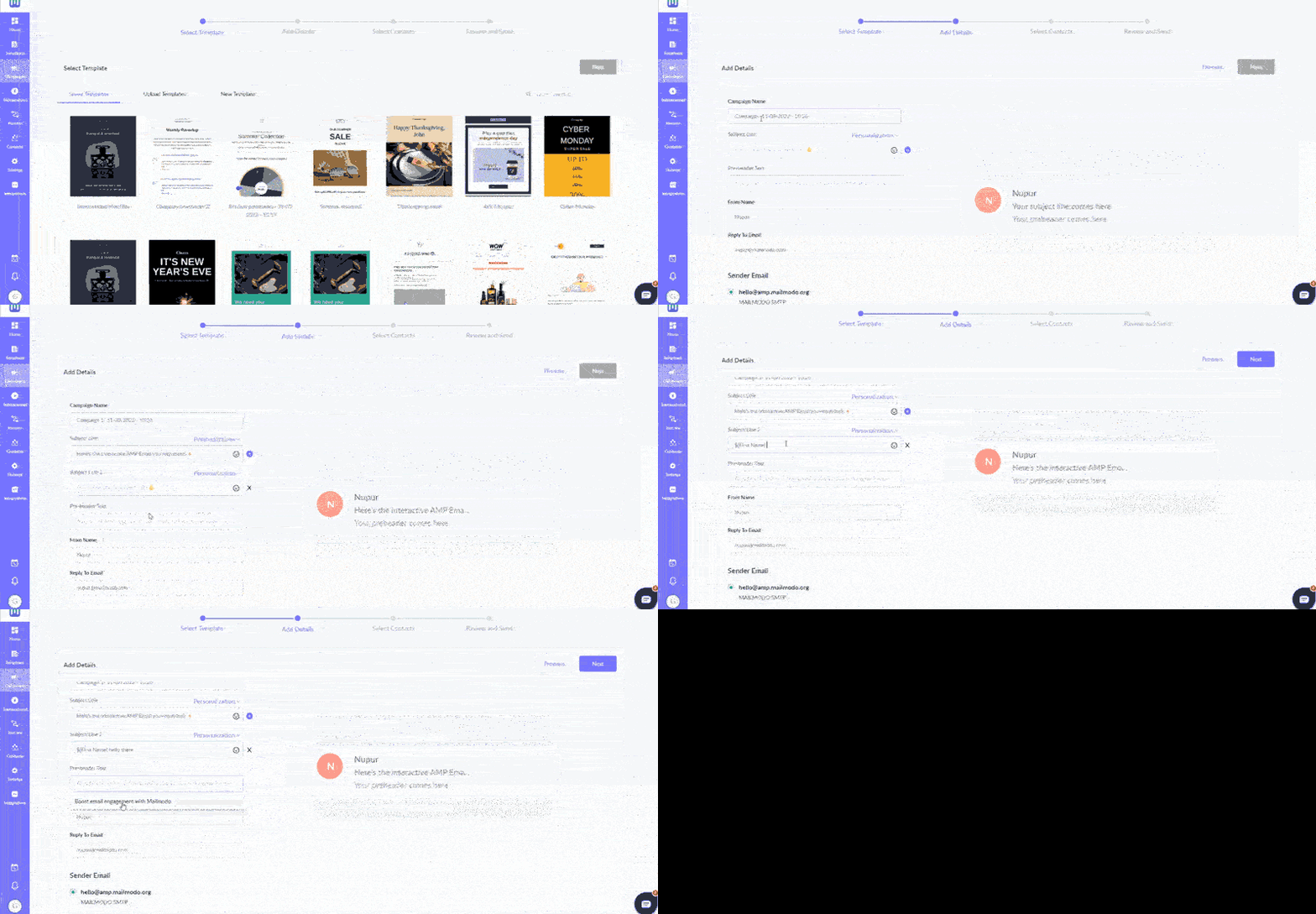
We recently did a subject line testing for our ebook, and here is what one of our survey participants shared about why he opened a specific type of subject line.
I believe it was the call-to-action and the question mark combo. I wanted to click on the email to get more information and see what I could do.
- David Sides, Director of Outreach, Second Eclipse
7. Provide a clear call to action
According to WordStream, emails featuring a single, focused CTA saw a 371% increase in clicks and a 161% boost in sales compared to emails with multiple CTAs.
To make your CTA truly effective:
Keep it simple and direct. Make sure your CTA stands out visually. Whether it’s a button or a bold link, it should be impossible to miss
Focus on the benefit, as in telling users what’s in it for them.
Use action-driven phrases like: “Claim your free guide”, “Start saving today” or “Get instant access
8. Build an email design system
According to Mindbody lifecycle marketer Katie Zeff, brands that use a cohesive email design system can cut production time by up to 50% due to improved design clarity.
Not only that, but developing your unique email design system ensures a cohesive appearance throughout. This fosters a trustworthy brand image.
By incorporating your brand's colors and fonts, you reinforce your brand identity and enhance brand recall. This, in turn, helps your audience remember your brand when they encounter it in various contexts.
Check out Mailmodo's email design system playbook to get inspired by successful email design systems across different industries and verticals and build one for your brand.
9. Gamify your emails
Using gamified email experiences can significantly increase revenue and drive high levels of engagement. For example, BluSmart embedded AMP quizzes into their emails, achieving a 35% form submission rate without requiring users to leave the inbox. That’s the power of interactive experiences.
Here are six interactive widgets that you can incorporate to gamify your emails:
The submission rate on the mail was surprisingly higher than we expected. The customers interacted with the email actively and got to learn insights about BluSmart through the questions asked.
- Shobhit Mehrotra, Growth Marketing, BluSmart
Re-engagement emails can recover up to 45% of dormant users, according to Return Path. Considering that 60% of the average email list is inactive, re-engagement campaigns offer one of the best ROI opportunities.
Start by segmenting your audience based on campaign activity or contact rating to identify inactive subscribers. Then use one of the following tactics :
Automate re-engagement email series: Set up a series of re-engagement email series to be sent automatically over a period of time. You can set whatever delay time you prefer. Additionally, you can implement post-send actions such as unsubscribing individuals or moving them to different groups after they complete the series.
Add polls and surveys inside emails: Encourage subscribers to participate in a poll or survey and offer them a complimentary gift or promo code upon completion..
Give customised product recommendations: Integrate your Shopify store with Mailmodo to gather data on your contacts' purchasing behavior. Using this data, Mailmodo can generate personalized product recommendations for each contact.
11. Provide exclusive discounts and offers
Discount offer emails are an effective way to promote your business, increase sales, engage potential customers, and generate more revenue. The best part of these emails is that they are particularly valuable for re-engaging dormant or inactive users by presenting them with an irresistible offer they can't resist.

12. Host a contest with freebies
Contest invitation emails are an effective promotional tool to generate excitement and curiosity among your subscribers. A study by Wishpond found that emails with Contest CTA’s have a 3.73% higher conversion rate when compared to other CTA’s.

13. Automate to send timely messages
Timing is everything in email marketing, and automation makes perfect timing possible. You can send targeted emails based on their website action or the customer journey stage.
Some essential automated emails include:
According to Experian , customers who receive automated cart abandonment emails are 2.4x more likely to complete their purchase than those who don’t.
Platforms like Mailmodo make automation intuitive with a visual journey builder. You can trigger emails using conditional logic, like user actions, and deliver exactly what your audience needs.
Understanding your audience is important. Once you know where they are in their customer journey, and what they are looking for, you can craft a better email marketing strategy. With personalization and automation, you can time it better.
-Mithun Jhawar, Associate Director of Marketing, SplashLearn
14. Test different variations of email
Data can make big performance testing in email marketing. That’s why A/B testing testing is essential in email marketing. It allows you to test different elements of your emails, such as subject lines, CTAs, visuals, or content structure, to see what resonates most with your audience.
According to Litmus, marketers who A/B test their emails see a 28% higher ROI compared to those who don’t.
Here’s what you can test:
Subject lines: Compare short vs. long, or personalized vs. generic to see which grabs more attention.
CTA text and placement: Experiment with different action phrases and button locations to find what drives clicks.
Email layout: Test simple single-column designs against multi-column formats for readability and engagement.
Visual elements: Try emails with images versus text-only to understand your audience’s preference.
Send time: Analyze whether sending emails in the morning, afternoon, or evening yields better open rates.
Using platforms like Mailmodo, you can easily run A/B tests, analyze performance, and iterate for better results in future campaigns.
15. Monitor and analyze email metrics
Tracking your email campaign performance is essential to understand what’s working and what isn’t. Key metrics like open rates, click-through rates, conversion rates, and unsubscribe rates provide valuable insights into your audience’s engagement and campaign effectiveness.
Additionally, monitor email deliverability as in the percentage of emails reaching inboxes, to avoid spam filters and maximize reach. Keeping your subscriber list clean by removing inactive contacts and verifying email addresses helps maintain a healthy audience.
Create campaign ideas with
AI Email Campaign Planner
Wrap up
Email marketing continues to be a better medium to communicate with your customers. You can get the most out of every campaign by developing a robust and fool-proof strategy driven by data and actionable insights.
As it is impossible manually, investing in a smart, intuitive, and versatile email service provider like Mailmodo can be a good decision for marketers and business owners.